Transcribed from the 1905 Chapman and wooden train sets for 10 year olds under 20 dollarsHall edition (TheWorks of Charles Dickens, volume 28) by David Price, [email protected]
The Lazy Tour of Two IdleApprentices
By CHARLES DICKENS
With Illustrations by HarryFurniss and A. J. Goodman
LONDON: CHAPMAN & HALL, LD.
NEW YORK: CHARLES SCRIBNER’S SONS
1905
CHAPTER I
In the autumn month of September,eighteen hundred and fifty-seven, wherein these presents beardate, two idle apprentices, exhausted by the long, hot summer,and the long, hot work it had brought with it, ran away fromtheir employer. They were bound to a highly meritoriouslady (named Literature), of fair credit and repute, though, itmust be acknowledged, not quite so highly esteemed in the City asshe might be. This is the more remarkable, as there isnothing against the respectable lady in that quarter, but quitethe contrary; her family having rendered eminent service to manyfamous citizens of London. It may be sufficient to name SirWilliam Walworth, Lord Mayor under King Richard II., at the timeof Wat Tyler’s insurrection, and Sir Richard Whittington:which latter distinguished man and magistrate was doubtlessindebted to the lady’s family for the gift of hiscelebrated cat. There is also strong reason to suppose thatthey rang the Highgate bells for him with their own hands.
The misguided young men who thus shirked their duty to themistress from whom they had received many favours, were actuatedby the low idea of making a perfectly idle trip, in anydirection. They had no intention of going anywhere inparticular; they wanted to see nothing, they wanted to knownothing, they wanted to learn nothing, they wanted to donothing. They wanted only to be idle. They took tothemselves (after Hogarth), the namesof Mr. Thomas Idle and Mr. Francis Goodchild; but there was not amoral pin to choose between them, and they were both idle in thelast degree.
Between Francis and Thomas, however, there was this differenceof character: Goodchild was laboriously idle, and would take uponhimself any amount of pains and labour to assure himself that hewas idle; in short, had no better idea of idleness than that itwas useless industry. Thomas Idle, on the other hand, wasan idler of the unmixed Irish or Neapolitan type; a passiveidler, a born-and-bred idler, a consistent idler, who practisedwhat he would have preached if he had not been too idle topreach; a one entire and perfect chrysolite of idleness.
The two idle apprentices found themselves, within a few hoursof their escape, walking down into the North of England, that isto say, Thomas was lying in a meadow, looking at the railwaytrains as they passed over a distant viaduct—which washisidea of walking down into the North; while Francis waswalking a mile due South against time—which was hisidea of walking down into the North. In the meantime theday waned, and the milestones remained unconquered.
‘Tom,’ said Goodchild, ‘the sun is gettinglow. Up, and let us go forward!’
‘Nay,’ quoth Thomas Idle, ‘I have not donewith Annie Laurie yet.’ And he proceeded with thatidle but popular ballad, to the effect that for the bonnie youngperson of that name he would ‘lay him doon anddee’—equivalent, in prose, to lay him down anddie.
‘What an ass that fellow was!’ cried Goodchild,with the bitter emphasis of contempt.
‘Which fellow?’ asked Thomas Idle.
‘The fellow in your song. Lay him doon anddee! Finely he’d show off before the girl by doingthat. A sniveller! Why couldn’t he getup, and punch somebody’s head!’
‘Whose?’ asked Thomas Idle.
‘Anybody’s. Everybody’s would bebetter than nobody’s! If I fell into that state ofmind about a girl, do you think I’d lay me doon anddee? No, sir,’ proceeded Goodchild, with adisparaging assumption of the Scottish accent, ‘I’dget me oop and peetch into somebody. Wouldn’tyou?’
‘I wouldn’t have anything to do with her,’yawned Thomas Idle. ‘Why should I take thetrouble?’
‘It’s no trouble, Tom, to fall in love,’said Goodchild, shaking his head.
‘It’s trouble enough to fall out of it, onceyou’re in it,’ retorted Tom. ‘So I keepout of it altogether. It would be better for you, if youdid the same.’
Mr. Goodchild, who is always in love with somebody, and notunfrequently with several objects at once, made no reply. He heaved a sigh of the kind which is termed by the lower orders‘a bellowser,’ and then, heaving Mr. Idle on his feet(who was not half so heavy as the sigh), urged him northward.
These two had sent their personal baggage on by train: onlyretaining each a knapsack. Idle now applied himself toconstantly regretting the train, to tracking it through theintricacies of Bradshaw’s Guide, and finding out where itis now—and where now—and where now—and toasking what was the use of walking, when you could ride at such apace as that. Was it to see the country? If that wasthe object, look at it out of the carriage windows. Therewas a great deal more of it to be seen there than here. Besides, who wanted to see the country? Nobody. Andagain, whoever did walk? Nobody. Fellows set off towalk, but they never did it. They came back and said theydid, but they didn’t. Then why should he walk? He wouldn’t walk. He swore it by this milestone!
It was the fifth from London, so far had they penetrated intothe North. Submitting to the powerful chain of argument,Goodchild proposed a return to the Metropolis, and a falling backupon Euston Square Terminus. Thomas assented with alacrity,and so they walked down into the North by the nextmorning’s express, and carried their knapsacks in theluggage-van.
It was like all other expresses, as every express is and mustbe. It bore through the harvest country a smell like alarge washing-day, and a sharp issue of steam as from a hugebrazen tea-urn. The greatest power in nature and artcombined, it yet glided over dangerous heights in the sight ofpeople looking up from fields and roads, as smoothly and unreallyas a light miniature plaything. Now, the engine shrieked inhysterics of such intensity, that it seemed desirable that themen who had her in charge should hold her feet, slap her hands,and bring her to; now, burrowed into tunnels with a stubborn andundemonstrative energy so confusing that the train seemed to beflying back into leagues of darkness. Here, were stationafter station, swallowed up by the express without stopping;here, stations where it fired itself in like a volley ofcannon-balls, swooped away four country-people with nosegays, andthree men of business with portmanteaus, and fired itself offagain, bang, bang, bang! At long intervals wereuncomfortable refreshment-rooms, made more uncomfortable by thescorn of Beauty towards Beast, the public (but to whom she neverrelented, as Beauty did in the story, towards the other Beast),and where sensitive stomachs were fed, with a contemptuoussharpness occasioning indigestion. Here, again, werestations with nothing going but a bell, and wonderful woodenrazors set aloft on great posts, shaving the air. In thesefields, the horses, sheep, and cattle were well used to thethundering meteor, and didn’t mind; in those, they were allset scampering together, and a herd of pigs scoured afterthem. The pastoral country darkened, became coaly, becamesmoky, became infernal, got better, got worse, improved again,grew rugged, turned romantic; was a wood, a stream, a chain ofhills, a gorge, a moor, a cathedral town, a fortified place, awaste. Now, miserable black dwellings, a black canal, andsick black towers of chimneys; now, a trim garden, where theflowers were bright and fair; now, a wilderness of hideous altarsall a-blaze; now, the water meadows with their fairy rings; now,the mangy patch of unlet building ground outside the stagnanttown, with the larger ring where the Circus was last week. The temperature changed, the dialect changed, the people changed,faces got sharper, manner got shorter, eyes got shrewder andharder; yet all so quickly, that the spruce guard in the Londonuniform and silver lace, had not yet rumpled his shirt-collar,delivered half the dispatches in his shiny little pouch, or readhis newspaper.
Carlisle! Idle and Goodchild had got to Carlisle. It looked congenially and delightfully idle. Something inthe way of public amusement had happened last month, andsomething else was going to happen before Christmas; and, in themeantime there was a lecture on India for those who likedit—which Idle and Goodchild did not. Likewise, bythose who liked them, there were impressions to be bought of allthe vapid prints, going and gone, and of nearly all the vapidbooks. For those who wanted to put anything in missionaryboxes, here were the boxes. For those who wanted theReverend Mr. Podgers (artist’s proofs, thirty shillings),here was Mr. Podgers to any amount. Not less gracious andabundant, Mr. Codgers also of the vineyard, but opposed to Mr.Podgers, brotherly tooth and nail. Here, were guide-booksto the neighbouring antiquities, and eke the Lake country, inseveral dry and husky sorts; here, many physically and morallyimpossible heads of both sexes, for young ladies to copy, in theexercise of the art of drawing; here, further, a large impressionof Mr. Spurgeon, solid as to theflesh, not to say even something gross. The working youngmen of Carlisle were drawn up, with their hands in their pockets,across the pavements, four and six abreast, and appeared (much tothe satisfaction of Mr. Idle) to have nothing else to do. The working and growing young women of Carlisle, from the age oftwelve upwards, promenaded the streets in the cool of theevening, and rallied the said young men. Sometimes theyoung men rallied the young women, as in the case of a groupgathered round an accordion-player, from among whom a young manadvanced behind a young woman for whom he appeared to have atenderness, and hinted to her that he was there and playful, bygiving her (he wore clogs) a kick.
On market morning, Carlisle woke up amazingly, and became (tothe two Idle Apprentices) disagreeably and reproachfullybusy. There were its cattle market, its sheep market, andits pig market down by the river, with raw-boned and shock-headedRob Roys hiding their Lowland dresses beneath heavy plaids,prowling in and out among the animals, and flavouring the airwith fumes of whiskey. There was its corn market down themain street, with hum of chaffering over open sacks. Therewas its general market in the street too, with heather brooms onwhich the purple flower still flourished, and heather basketsprimitive and fresh to behold. With women trying on clogsand caps at open stalls, and ‘Bible stalls’adjoining. With ‘Doctor Mantle’s Dispensary forthe cure of all Human Maladies and no charge for advice,’and with Doctor Mantle’s ‘Laboratory of Medical,Chemical, and Botanical Science’—both healinginstitutions established on one pair of trestles, one board, andone sun-blind. With the renowned phrenologist from London,begging to be favoured (at sixpence each) with the company ofclients of both sexes, to whom, on examination of their heads, hewould make revelations ‘enabling him or her to knowthemselves.’ Through all these bargains andblessings, the recruiting-sergeant watchfully elbowed his way, athread of War in the peaceful skein. Likewise on the wallswere printed hints that the Oxford Blues might not be indisposedto hear of a few fine active young men; and that whereas thestandard of that distinguished corps is full six feet,‘growing lads of five feet eleven’ need notabsolutely despair of being accepted.
Scenting the morning air more pleasantly than the buriedmajesty of Denmark did, Messrs. Idle and Goodchild rode away fromCarlisle at eight o’clock one forenoon, bound for thevillage of Hesket, Newmarket, some fourteen miles distant. Goodchild (who had already begun to doubt whether he was idle: ashis way always is when he has nothing to do) had read of acertain black old Cumberland hill or mountain, called Carrock, orCarrock Fell; and had arrived at the conclusion that it would bethe culminating triumph of Idleness to ascend the same. Thomas Idle, dwelling on the pains inseparable from thatachievement, had expressed the strongest doubts of theexpediency, and even of the sanity, of the enterprise; butGoodchild had carried his point, and they rode away.
Up hill and down hill, and twisting to the right, and twistingto the left, and with old Skiddaw (who has vaunted himself agreat deal more than his merits deserve; but that is rather theway of the Lake country), dodging the apprentices in apicturesque and pleasant manner. Good, weather-proof, warm,pleasant houses, well white-limed, scantily dotting theroad. Clean children coming out to look, carrying otherclean children as big as themselves. Harvest still lyingout and much rained upon; here and there, harvest stillunreaped. Well-cultivated gardens attached to the cottages,with plenty of produce forced out of their hard soil. Lonely nooks, and wild; but people can be born, and married, andburied in such nooks, and can live and love, and be loved, thereas elsewhere, thank God! (Mr. Goodchild’s remark.) By-and-by, the village. Black, coarse-stoned,rough-windowed houses; some with outer staircases, like Swisshouses; a sinuous and stony gutter winding up hill and round thecorner, by way of street. All the children running outdirectly. Women pausing in washing, to peep from doorwaysand very little windows. Such were the observations ofMessrs. Idle and Goodchild, as their conveyance stopped at thevillage shoemaker’s. Old Carrock gloomed down upon itall in a very ill-tempered state; and rain was beginning.
The village shoemaker declined to have anything to do withCarrock. No visitors went up Carrock. No visitorscame there at all. Aa’ the world ganged awa’yon. The driver appealed to the Innkeeper. TheInnkeeper had two men working in the fields, and one of themshould be called in, to go up Carrock as guide. Messrs.Idle and Goodchild, highly approving, entered theInnkeeper’s house, to drink whiskey and eat oatcake.
The Innkeeper was not idle enough—was not idle at all,which was a great fault in him—but was a fine specimen of anorth-country man, or any kind of man. He had a ruddycheek, a bright eye, a well-knit frame, an immense hand, acheery, outspeaking voice, and a straight, bright, broadlook. He had a drawing-room, too, upstairs, which was wortha visit to the Cumberland Fells. (This was Mr. FrancisGoodchild’s opinion, in which Mr. Thomas Idle did notconcur.)
The ceiling of this drawing-room was so crossed and recrossedby beams of unequal lengths, radiating from a centre, in acorner, that it looked like a broken star-fish. The roomwas comfortably and solidly furnished with good mahogany andhorsehair. It had a snug fireside, and a couple ofwell-curtained windows, looking out upon the wild country behindthe house. What it most developed was, an unexpected tastefor little ornaments and nick-nacks, of which it contained a mostsurprising number. They were not very various, consistingin great part of waxen babies with their limbs more or lessmutilated, appealing on one leg to the parental affections fromunder little cupping glasses; but, Uncle Tom was there, incrockery, receiving theological instructions from Miss Eva, whogrew out of his side like a wen, in an exceedingly rough state ofprofile propagandism. Engravings of Mr. Hunt’scountry boy, before and after his pie, were on the wall, dividedby a highly-coloured nautical piece, the subject of which had allher colours (and more) flying, and was making great way through asea of a regular pattern, like a lady’s collar. Abenevolent, elderly gentleman of the last century, with apowdered head, kept guard, in oil and varnish, over a mostperplexing piece of furniture on a table; in appearance between adriving seat and an angular knife-box, but, when opened, amusical instrument of tinkling wires, exactly like David’sharp packed for travelling. Everything became a nick-nackin this curious room. The copper tea-kettle, burnished upto the highest point of glory, took his station on a stand of hisown at the greatest possible distance from the fireplace, andsaid: ‘By your leave, not a kettle, but abijou.’ The Staffordshire-ware butter-dish with thecover on, got upon a little round occasional table in a window,with a worked top, and announced itself to the two chairsaccidentally placed there, as an aid to polite conversation, agraceful trifle in china to be chatted over by callers, as theyairily trifled away the visiting moments of a butterflyexistence, in that rugged old village on the CumberlandFells. The very footstool could not keep the floor, but gotupon a sofa, and there-from proclaimed itself, in high relief ofwhite and liver-coloured wool, a favourite spaniel coiled up forrepose. Though, truly, in spite of its bright glass eyes,the spaniel was the least successful assumption in thecollection: being perfectly flat, and dismally suggestive of arecent mistake in sitting down on the part of some corpulentmember of the family.
There were books, too, in this room; books on the table, bookson the chimney-piece, books in an open press in the corner. Fielding was there, and Smollett was there, and Steele andAddison were there, in dispersed volumes; and there were tales ofthose who go down to the sea in ships, for windy nights; andthere was really a choice of good books for rainy days orfine. It was so very pleasant to see these things in such alonesome by-place—so very agreeable to find these evidencesof a taste, however homely, that went beyond the beautifulcleanliness and trimness of the house—so fanciful toimagine what a wonder a room must be to the little children bornin the gloomy village—what grand impressions of it those ofthem who became wanderers over the earth would carry away; andhow, at distant ends of the world, some old voyagers would die,cherishing the belief that the finest apartment known to men wasonce in the Hesket-Newmarket Inn, in rare old Cumberland—itwas such a charmingly lazy pursuit to entertain these ramblingthoughts over the choice oatcake and the genial whiskey, that Mr.Idle and Mr. Goodchild never asked themselves how it came to passthat the men in the fields were never heard of more, how thestalwart landlord replaced them without explanation, how hisdog-cart came to be waiting at the door, and how everything wasarranged without the least arrangement for climbing to oldCarrock’s shoulders, and standing on his head.
Without a word of inquiry, therefore, the Two Idle Apprenticesdrifted out resignedly into a fine, soft, close, drowsy,penetrating rain; got into the landlord’s light dog-cart,and rattled off through the village for the foot ofCarrock. The journey at the outset was notremarkable. The Cumberland road went up and down like allother roads; the Cumberland curs burst out from backs of cottagesand barked like other curs, and the Cumberland peasantry staredafter the dog-cart amazedly, as long as it was in sight, like therest of their race. The approach to the foot of themountain resembled the approaches to the feet of most othermountains all over the world. The cultivation graduallyceased, the trees grew gradually rare, the road became graduallyrougher, and the sides of the mountain looked gradually more andmore lofty, and more and more difficult to get up. Thedog-cart was left at a lonely farm-house. The landlordborrowed a large umbrella, and, assuming in an instant thecharacter of the most cheerful and adventurous of guides, led theway to the ascent. Mr. Goodchild looked eagerly at the topof the mountain, and, feeling apparently that he was now going tobe very lazy indeed, shone all over wonderfully to the eye, underthe influence of the contentment within and the moisturewithout. Only in the bosom of Mr. Thomas Idle didDespondency now hold her gloomy state. He kept it a secret;but he would have given a very handsome sum, when the ascentbegan, to have been back again at the inn. The sides ofCarrock looked fearfully steep, and the top of Carrock was hiddenin mist. The rain was falling faster and faster. Theknees of Mr. Idle—always weak on walkingexcursions—shivered and shook with fear and damp. Thewet was already penetrating through the young man’s outercoat to a brand-new shooting-jacket, for which he had reluctantlypaid the large sum of two guineas on leaving town; he had nostimulating refreshment about him but a small packet of clammygingerbread nuts; he had nobody to give him an arm, nobody topush him gently behind, nobody to pull him up tenderly in front,nobody to speak to who really felt the difficulties of theascent, the dampness of the rain, the denseness of the mist, andthe unutterable folly of climbing, undriven, up any steep placein the world, when there is level ground within reach to walk oninstead. Was it for this that Thomas had left London? London, where there are nice short walks in level public gardens,with benches of repose set up at convenient distances for wearytravellers—London, where rugged stone is humanely poundedinto little lumps for the road, and intelligently shaped intosmooth slabs for the pavement! No! it was not for thelaborious ascent of the crags of Carrock that Idle had left hisnative city, and travelled to Cumberland. Never did he feelmore disastrously convinced that he had committed a very graveerror in judgment than when he found himself standing in the rainat the bottom of a steep mountain, and knew that theresponsibility rested on his weak shoulders of actually gettingto the top of it.
The honest landlord went first, the beaming Goodchildfollowed, the mournful Idle brought up the rear. From timeto time, the two foremost members of the expedition changedplaces in the order of march; but the rearguard never altered hisposition. Up the mountain or down the mountain, in thewater or out of it, over the rocks, through the bogs, skirtingthe heather, Mr. Thomas Idle was always the last, and was alwaysthe man who had to be looked after and waited for. At firstthe ascent was delusively easy, the sides of the mountain slopedgradually, and the material of which they were composed was asoft spongy turf, very tender and pleasant to walk upon. After a hundred yards or so, however, the verdant scene and theeasy slope disappeared, and the rocks began. Not noble,massive rocks, standing upright, keeping a certain regularity intheir positions, and possessing, now and then, flat tops to situpon, but little irritating, comfortless rocks, littered aboutanyhow, by Nature; treacherous, disheartening rocks of all sortsof small shapes and small sizes, bruisers of tender toes andtrippers-up of wavering feet. When these impediments werepassed, heather and slough followed. Here the steepness ofthe ascent was slightly mitigated; and here the exploring partyof three turned round to look at the view below them. Thescene of the moorland and the fields was like a feeblewater-colour drawing half sponged out. The mist wasdarkening, the rain was thickening, the trees were dotted aboutlike spots of faint shadow, the division-lines which mapped outthe fields were all getting blurred together, and the lonelyfarm-house where the dog-cart had been left, loomed spectral inthe grey light like the last human dwelling at the end of thehabitable world. Was this a sight worth climbing tosee? Surely—surely not!
Up again—for the top of Carrock is not reachedyet. The land-lord, just as good-tempered and obliging ashe was at the bottom of the mountain. Mr. Goodchildbrighter in the eyes and rosier in the face than ever; full ofcheerful remarks and apt quotations; and walking with aspringiness of step wonderful to behold. Mr. Idle, fartherand farther in the rear, with the water squeaking in the toes ofhis boots, with his two-guinea shooting-jacket clinging damply tohis aching sides, with his overcoat so full of rain, and standingout so pyramidically stiff, in consequence, from his shouldersdownwards, that he felt as if he was walking in a giganticextinguisher—the despairing spirit within him representingbut too aptly the candle that had just been put out. Up andup and up again, till a ridge is reached and the outer edge ofthe mist on the summit of Carrock is darkly and drizzinglynear. Is this the top? No, nothing like thetop. It is an aggravating peculiarity of all mountains,that, although they have only one top when they are seen (as theyought always to be seen) from below, they turn out to have aperfect eruption of false tops whenever the traveller issufficiently ill-advised to go out of his way for the purpose ofascending them. Carrock is but a trumpery little mountainof fifteen hundred feet, and it presumes to have false tops, andeven precipices, as if it were Mont Blanc. No matter;Goodchild enjoys it, and will go on; and Idle, who is afraid ofbeing left behind by himself, must follow. On entering theedge of the mist, the landlord stops, and says he hopes that itwill not get any thicker. It is twenty years since he lastascended Carrock, and it is barely possible, if the mistincreases, that the party may be lost on the mountain. Goodchild hears this dreadful intimation, and is not in the leastimpressed by it. He marches for the top that is never to befound, as if he was the Wandering Jew, bound to go on for ever,in defiance of everything. The landlord faithfullyaccompanies him. The two, to the dim eye of Idle, farbelow, look in the exaggerative mist, like a pair of friendlygiants, mounting the steps of some invisible castletogether. Up and up, and then down a little, and then up,and then along a strip of level ground, and then up again. The wind, a wind unknown in the happy valley, blows keen andstrong; the rain-mist gets impenetrable; a dreary little cairn ofstones appears. The landlord adds one to the heap, firstwalking all round the cairn as if he were about to perform anincantation, then dropping the stone on to the top of the heapwith the gesture of a magician adding an ingredient to a cauldronin full bubble. Goodchild sits down by the cairn as if itwas his study-table at home; Idle, drenched and panting, standsup with his back to the wind, ascertains distinctly that this isthe top at last, looks round with all the little curiosity thatis left in him, and gets, in return, a magnificent viewof—Nothing!
The effect of this sublime spectacle on the minds of theexploring party is a little injured by the nature of the directconclusion to which the sight of it points—the saidconclusion being that the mountain mist has actually gatheredround them, as the landlord feared it would. It now becomesimperatively necessary to settle the exact situation of thefarm-house in the valley at which the dog-cart has been left,before the travellers attempt to descend. While thelandlord is endeavouring to make this discovery in his own way,Mr. Goodchild plunges his hand under his wet coat, draws out alittle red morocco-case, opens it, and displays to the view ofhis companions a neat pocket-compass. The north is found,the point at which the farm-house is situated is settled, and thedescent begins. After a little downward walking, Idle(behind as usual) sees his fellow-travellers turn asidesharply—tries to follow them—loses them in themist—is shouted after, waited for, recovered—and thenfinds that a halt has been ordered, partly on his account, partlyfor the purpose of again consulting the compass.
The point in debate is settled as before between Goodchild andthe landlord, and the expedition moves on, not down the mountain,but marching straight forward round the slope of it. Thedifficulty of following this new route is acutely felt by ThomasIdle. He finds the hardship of walking at all greatlyincreased by the fatigue of moving his feet straight forwardalong the side of a slope, when their natural tendency, at everystep, is to turn off at a right angle, and go straight down thedeclivity. Let the reader imagine himself to be walkingalong the roof of a barn, instead of up or down it, and he willhave an exact idea of the pedestrian difficulty in which thetravellers had now involved themselves. In ten minutes moreIdle was lost in the distance again, was shouted for, waited for,recovered as before; found Goodchild repeating his observation ofthe compass, and remonstrated warmly against the sideway routethat his companions persisted in following. It appeared tothe uninstructed mind of Thomas that when three men want to getto the bottom of a mountain, their business is to walk down it;and he put this view of the case, not only with emphasis, buteven with some irritability. He was answered from thescientific eminence of the compass on which his companions weremounted, that there was a frightful chasm somewhere near the footof Carrock, called The Black Arches, into which the travellerswere sure to march in the mist, if they risked continuing thedescent from the place where they had now halted. Idlereceived this answer with the silent respect which was due to thecommanders of the expedition, and followed along the roof of thebarn, or rather the side of the mountain, reflecting upon theassurance which he received on starting again, that the object ofthe party was only to gain ‘a certain point,’ and,this haven attained, to continue the descent afterwards until thefoot of Carrock was reached. Though quite unexceptionableas an abstract form of expression, the phrase ‘a certainpoint’ has the disadvantage of sounding rather vaguely whenit is pronounced on unknown ground, under a canopy of mist muchthicker than a London fog. Nevertheless, after the compass,this phrase was all the clue the party had to hold by, and Idleclung to the extreme end of it as hopefully as he could.
More sideway walking, thicker and thicker mist, all sorts ofpoints reached except the ‘certain point;’ third lossof Idle, third shouts for him, third recovery of him, thirdconsultation of compass. Mr. Goodchild draws it tenderlyfrom his pocket, and prepares to adjust it on a stone. Something falls on the turf—it is the glass. Something else drops immediately after—it is theneedle. The compass is broken, and the exploring party islost!
It is the practice of the English portion of the human race toreceive all great disasters in dead silence. Mr. Goodchildrestored the useless compass to his pocket without saying a word,Mr. Idle looked at the landlord, and the landlord looked at Mr.Idle. There was nothing for it now but to go on blindfold,and trust to the chapter of chances. Accordingly, the losttravellers moved forward, still walking round the slope of themountain, still desperately resolved to avoid the Black Arches,and to succeed in reaching the ‘certain point.’
A quarter of an hour brought them to the brink of a ravine, atthe bottom of which there flowed a muddy little stream. Here another halt was called, and another consultation tookplace. The landlord, still clinging pertinaciously to theidea of reaching the ‘point,’ voted for crossing theravine, and going on round the slope of the mountain. Mr.Goodchild, to the great relief of his fellow-traveller, tookanother view of the case, and backed Mr. Idle’s proposal todescend Carrock at once, at any hazard—the rather as therunning stream was a sure guide to follow from the mountain tothe valley. Accordingly, the party descended to the ruggedand stony banks of the stream; and here again Thomas lost groundsadly, and fell far behind his travelling companions. Notmuch more than six weeks had elapsed since he had sprained one ofhis ankles, and he began to feel this same ankle getting ratherweak when he found himself among the stones that were strewnabout the running water. Goodchild and the landlord weregetting farther and farther ahead of him. He saw them crossthe stream and disappear round a projection on its banks. He heard them shout the moment after as a signal that they hadhalted and were waiting for him. Answering the shout, hemended his pace, crossed the stream where they had crossed it,and was within one step of the opposite bank, when his footslipped on a wet stone, his weak ankle gave a twist outwards, ahot, rending, tearing pain ran through it at the same moment, anddown fell the idlest of the Two Idle Apprentices, crippled in aninstant.
The situation was now, in plain terms, one of absolutedanger. There lay Mr. Idle writhing with pain, there wasthe mist as thick as ever, there was the landlord as completelylost as the strangers whom he was conducting, and there was thecompass broken in Goodchild’s pocket. To leave thewretched Thomas on unknown ground was plainly impossible; and toget him to walk with a badly sprained ankle seemed equally out ofthe question. However, Goodchild (brought back by his cryfor help) bandaged the ankle with a pocket-handkerchief, andassisted by the landlord, raised the crippled Apprentice to hislegs, offered him a shoulder to lean on, and exhorted him for thesake of the whole party to try if he could walk. Thomas,assisted by the shoulder on one side, and a stick on the other,did try, with what pain and difficulty those only can imagine whohave sprained an ankle and have had to tread on itafterwards. At a pace adapted to the feeble hobbling of anewly-lamed man, the lost party moved on, perfectly ignorantwhether they were on the right side of the mountain or the wrong,and equally uncertain how long Idle would be able to contend withthe pain in his ankle, before he gave in altogether and fell downagain, unable to stir another step.
Slowly and more slowly, as the clog of crippled Thomas weighedheavily and more heavily on the march of the expedition, the losttravellers followed the windings of the stream, till they came toa faintly-marked cart-track, branching off nearly at rightangles, to the left. After a little consultation it wasresolved to follow this dim vestige of a road in the hope that itmight lead to some farm or cottage, at which Idle could be leftin safety. It was now getting on towards the afternoon, andit was fast becoming more than doubtful whether the party,delayed in their progress as they now were, might not beovertaken by the darkness before the right route was found, andbe condemned to pass the night on the mountain, without bit ordrop to comfort them, in their wet clothes.
The cart-track grew fainter and fainter, until it was washedout altogether by another little stream, dark, turbulent, andrapid. The landlord suggested, judging by the colour of thewater, that it must be flowing from one of the lead mines in theneighbourhood of Carrock; and the travellers accordingly kept bythe stream for a little while, in the hope of possibly wanderingtowards help in that way. After walking forward about twohundred yards, they came upon a mine indeed, but a mine,exhausted and abandoned; a dismal, ruinous place, with nothingbut the wreck of its works and buildings left to speak forit. Here, there were a few sheep feeding. Thelandlord looked at them earnestly, thought he recognised themarks on them—then thought he did not—finally gave upthe sheep in despair—and walked on just as ignorant of thewhereabouts of the party as ever.
The march in the dark, literally as well as metaphorically inthe dark, had now been continued for three-quarters of an hourfrom the time when the crippled Apprentice had met with hisaccident. Mr. Idle, with all the will to conquer the painin his ankle, and to hobble on, found the power rapidly failinghim, and felt that another ten minutes at most would find him atthe end of his last physical resources. He had just made uphis mind on this point, and was about to communicate the dismalresult of his reflections to his companions, when the mistsuddenly brightened, and begun to lift straight ahead. Inanother minute, the landlord, who was in advance, proclaimed thathe saw a tree. Before long, other trees appeared—thena cottage—then a house beyond the cottage, and a familiarline of road rising behind it. Last of all, Carrock itselfloomed darkly into view, far away to the right hand. Theparty had not only got down the mountain without knowing how, buthad wandered away from it in the mist, without knowingwhy—away, far down on the very moor by which they hadapproached the base of Carrock that morning.
The happy lifting of the mist, and the still happier discoverythat the travellers had groped their way, though by a veryroundabout direction, to within a mile or so of the part of thevalley in which the farm-house was situated, restored Mr.Idle’s sinking spirits and reanimated his failingstrength. While the landlord ran off to get the dog-cart,Thomas was assisted by Goodchild to the cottage which had beenthe first building seen when the darkness brightened, and waspropped up against the garden wall, like an artist’s layfigure waiting to be forwarded, until the dog-cart should arrivefrom the farm-house below. In due time—and a verylong time it seemed to Mr. Idle—the rattle of wheels washeard, and the crippled Apprentice was lifted into theseat. As the dog-cart was driven back to the inn, thelandlord related an anecdote which he had just heard at thefarm-house, of an unhappy man who had been lost, like his twoguests and himself, on Carrock; who had passed the night therealone; who had been found the next morning, ‘scared andstarved;’ and who never went out afterwards, except on hisway to the grave. Mr. Idle heard this sad story, andderived at least one useful impression from it. Bad as thepain in his ankle was, he contrived to bear it patiently, for hefelt grateful that a worse accident had not befallen him in thewilds of Carrock.
CHAPTER II
The dog-cart, with Mr. Thomas Idleand his ankle on the hanging seat behind, Mr. Francis Goodchildand the Innkeeper in front, and the rain in spouts and splasheseverywhere, made the best of its way back to the little inn; thebroken moor country looking like miles upon miles of Pre-Adamitesop, or the ruins of some enormous jorum of antediluviantoast-and-water. The trees dripped; the eaves of thescattered cottages dripped; the barren stone walls dividing theland, dripped; the yelping dogs dripped; carts and waggons underill-roofed penthouses, dripped; melancholy cocks and hensperching on their shafts, or seeking shelter underneath them,dripped; Mr. Goodchild dripped; Thomas Idle dripped; theInn-keeper dripped; the mare dripped; the vast curtains of mistand cloud passed before the shadowy forms of the hills, streamedwater as they were drawn across the landscape. Down suchsteep pitches that the mare seemed to be trotting on her head,and up such steep pitches that she seemed to have a supplementaryleg in her tail, the dog-cart jolted and tilted back to thevillage. It was too wet for the women to look out, it wastoo wet even for the children to look out; all the doors andwindows were closed, and the only sign of life or motion was inthe rain-punctured puddles.
Whiskey and oil to Thomas Idle’s ankle, and whiskeywithout oil to Francis Goodchild’s stomach, produced anagreeable change in the systems of both; soothing Mr.Idle’s pain, which was sharp before, and sweetening Mr.Goodchild’s temper, which was sweet before. Portmanteaus being then opened and clothes changed, Mr.Goodchild, through having no change of outer garments butbroadcloth and velvet, suddenly became a magnificent portent inthe Innkeeper’s house, a shining frontispiece to thefashions for the month, and a frightful anomaly in the Cumberlandvillage.
Greatly ashamed of his splendid appearance, the consciousGoodchild quenched it as much as possible, in the shadow ofThomas Idle’s ankle, and in a corner of the little coveredcarriage that started with them for Wigton—a most desirablecarriage for any country, except for its having a flat roof andno sides; which caused the plumps of rain accumulating on theroof to play vigorous games of bagatelle into the interior allthe way, and to score immensely. It was comfortable to seehow the people coming back in open carts from Wigton market madeno more of the rain than if it were sunshine; how the Wigtonpoliceman taking a country walk of half-a-dozen miles (apparentlyfor pleasure), in resplendent uniform, accepted saturation as hisnormal state; how clerks and schoolmasters in black, loiteredalong the road without umbrellas, getting varnished at everystep; how the Cumberland girls, coming out to look after theCumberland cows, shook the rain from their eyelashes and laughedit away; and how the rain continued to fall upon all, as it onlydoes fall in hill countries.
Wigton market was over, and its bare booths were smoking withrain all down the street. Mr. Thomas Idle, melodramaticallycarried to the inn’s first floor, and laid upon threechairs (he should have had the sofa, if there had been one), Mr.Goodchild went to the window to take an observation of Wigton,and report what he saw to his disabled companion.
‘Brother Francis, brother Francis,’ cried ThomasIdle, ‘What do you see from the turret?’
‘I see,’ said Brother Francis, ‘what I hopeand believe to be one of the most dismal places ever seen byeyes. I see the houses with their roofs of dull black,their stained fronts, and their dark-rimmed windows, looking asif they were all in mourning. As every little puff of windcomes down the street, I see a perfect train of rain let offalong the wooden stalls in the market-place and exploded againstme. I see a very big gas lamp in the centre which I know,by a secret instinct, will not be lighted to-night. I see apump, with a trivet underneath its spout whereon to stand thevessels that are brought to be filled with water. I see aman come to pump, and he pumps very hard, but no water follows,and he strolls empty away.’
‘Brother Francis, brother Francis,’ cried ThomasIdle, ‘what more do you see from the turret, besides theman and the pump, and the trivet and the houses all in mourningand the rain?’
‘I see,’ said Brother Francis, ‘one, two,three, four, five, linen-drapers’ shops in front ofme. I see a linen-draper’s shop next door to theright—and there are five more linen-drapers’ shopsdown the corner to the left. Eleven homicidallinen-drapers’ shops within a short stone’s throw,each with its hands at the throats of all the rest! Overthe small first-floor of one of these linen-drapers’ shopsappears the wonderful inscription, Bank.’
‘Brother Francis, brother Francis,’ cried ThomasIdle, ‘what more do you see from the turret, besides theeleven homicidal linen-drapers’ shops, and the wonderfulinscription, “Bank,”—on the small first-floor,and the man and the pump and the trivet and the houses all inmourning and the rain?’
‘I see,’ said Brother Francis, ‘thedepository for Christian Knowledge, and through the dark vapour Ithink I again make out Mr. Spurgeon looming heavily. HerMajesty the Queen, God bless her, printed in colours, I am sure Isee. I see the Illustrated London Newsof severalyears ago, and I see a sweetmeat shop—which the proprietorcalls a “Salt Warehouse”—with one small femalechild in a cotton bonnet looking in on tip-toe, oblivious ofrain. And I see a watchmaker’s with only three greatpale watches of a dull metal hanging in his window, each in aseparate pane.’
‘Brother Francis, brother Francis,’ cried ThomasIdle, ‘what more do you see of Wigton, besides theseobjects, and the man and the pump and the trivet and the housesall in mourning and the rain?’
‘I see nothing more,’ said Brother Francis,‘and there is nothing more to see, except the curlpaperbill of the theatre, which was opened and shut last week (themanager’s family played all the parts), and the short,square, chinky omnibus that goes to the railway, and leads toorattling a life over the stones to hold together long. Oyes! Now, I see two men with their hands in their pocketsand their backs towards me.’
‘Brother Francis, brother Francis,’ cried ThomasIdle, ‘what do you make out from the turret, of theexpression of the two men with their hands in their pockets andtheir backs towards you?’
‘They are mysterious men,’ said Brother Francis,‘with inscrutable backs. They keep their backstowards me with persistency. If one turns an inch in anydirection, the other turns an inch in the same direction, and nomore. They turn very stiffly, on a very little pivot, inthe middle of the market-place. Their appearance is partlyof a mining, partly of a ploughing, partly of a stable,character. They are looking at nothing—veryhard. Their backs are slouched, and their legs are curvedwith much standing about. Their pockets are loose anddog’s-eared, on account of their hands being always inthem. They stand to be rained upon, without any movement ofimpatience or dissatisfaction, and they keep so close togetherthat an elbow of each jostles an elbow of the other, but theynever speak. They spit at times, but speak not. I seeit growing darker and darker, and still I see them, sole visiblepopulation of the place, standing to be rained upon with theirbacks towards me, and looking at nothing very hard.’
‘Brother Francis, brother Francis,’ cried ThomasIdle, ‘before you draw down the blind of the turret andcome in to have your head scorched by the hot gas, see if youcan, and impart to me, something of the expression of those twoamazing men.’
‘The murky shadows,’ said Francis Goodchild,‘are gathering fast; and the wings of evening, and thewings of coal, are folding over Wigton. Still, they look atnothing very hard, with their backs towards me. Ah! Now, they turn, and I see—’
‘Brother Francis, brother Francis,’ cried ThomasIdle, ‘tell me quickly what you see of the two men ofWigton!’
‘I see,’ said Francis Goodchild, ‘that theyhave no expression at all. And now the town goes to sleep,undazzled by the large unlighted lamp in the market-place; andlet no man wake it.’
At the close of the next day’s journey, Mr. ThomasIdle’s ankle became much swollen and inflamed. Thereare reasons which will presently explain themselves for notpublicly indicating the exact direction in which that journeylay, or the place in which it ended. It was a longday’s shaking of Thomas Idle over the rough roads, and along day’s getting out and going on before the horses, andfagging up hills, and scouring down hills, on the part of Mr.Goodchild, who in the fatigues of such labours congratulatedhimself on attaining a high point of idleness. It was at alittle town, still in Cumberland, that they halted for thenight—a very little town, with the purple and brown moorclose upon its one street; a curious little ancient market-crossset up in the midst of it; and the town itself looking much as ifit were a collection of great stones piled on end by the Druidslong ago, which a few recluse people had since hollowed out forhabitations.
‘Is there a doctor here?’ asked Mr. Goodchild, onhis knee, of the motherly landlady of the little Inn: stopping inhis examination of Mr. Idle’s ankle, with the aid of acandle.
‘Ey, my word!’ said the landlady, glancingdoubtfully at the ankle for herself; ‘there’s DoctorSpeddie.’
‘Is he a good Doctor?’
‘Ey!’ said the landlady, ‘I ca’ himso. A’ cooms efther nae doctor that I ken. Mairnor which, a’s just THEdoctor heer.’
‘Do you think he is at home?’
Her reply was, ‘Gang awa’, Jock, and bringhim.’
Jock, a white-headed boy, who, under pretence of stirring upsome bay salt in a basin of water for the laving of thisunfortunate ankle, had greatly enjoyed himself for the last tenminutes in splashing the carpet, set off promptly. A veryfew minutes had elapsed when he showed the Doctor in, by tumblingagainst the door before him and bursting it open with hishead.
‘Gently, Jock, gently,’ said the Doctor as headvanced with a quiet step. ‘Gentlemen, a goodevening. I am sorry that my presence is requiredhere. A slight accident, I hope? A slip and afall? Yes, yes, yes. Carrock, indeed? Hah! Does that pain you, sir? No doubt, itdoes. It is the great connecting ligament here, you see,that has been badly strained. Time and rest, sir! They are often the recipe in greater cases,’ with a slightsigh, ‘and often the recipe in small. I can send alotion to relieve you, but we must leave the cure to time andrest.’
This he said, holding Idle’s foot on his knee betweenhis two hands, as he sat over against him. He had touchedit tenderly and skilfully in explanation of what he said, and,when his careful examination was completed, softly returned it toits former horizontal position on a chair.
He spoke with a little irresolution whenever he began, butafterwards fluently. He was a tall, thin, large-boned, oldgentleman, with an appearance at first sight of beinghard-featured; but, at a second glance, the mild expression ofhis face and some particular touches of sweetness and patienceabout his mouth, corrected this impression and assigned his longprofessional rides, by day and night, in the bleak hill-weather,as the true cause of that appearance. He stooped verylittle, though past seventy and very grey. His dress wasmore like that of a clergyman than a country doctor, being aplain black suit, and a plain white neck-kerchief tied behindlike a band. His black was the worse for wear, and therewere darns in his coat, and his linen was a little frayed at thehems and edges. He might have been poor—it was likelyenough in that out-of-the-way spot—or he might have been alittle self-forgetful and eccentric. Any one could haveseen directly, that he had neither wife nor child at home. He had a scholarly air with him, and that kind of consideratehumanity towards others which claimed a gentle consideration forhimself. Mr. Goodchild made this study of him while he wasexamining the limb, and as he laid it down. Mr. Goodchildwishes to add that he considers it a very good likeness.
It came out in the course of a little conversation, thatDoctor Speddie was acquainted with some friends of ThomasIdle’s, and had, when a young man, passed some years inThomas Idle’s birthplace on the other side ofEngland. Certain idle labours, the fruit of Mr.Goodchild’s apprenticeship, also happened to be well knownto him. The lazy travellers were thus placed on a moreintimate footing with the Doctor than the casual circumstances ofthe meeting would of themselves have established; and when DoctorSpeddie rose to go home, remarking that he would send hisassistant with the lotion, Francis Goodchild said that wasunnecessary, for, by the Doctor’s leave, he would accompanyhim, and bring it back. (Having done nothing to fatiguehimself for a full quarter of an hour, Francis began to fear thathe was not in a state of idleness.)
Doctor Speddie politely assented to the proposition of FrancisGoodchild, ‘as it would give him the pleasure of enjoying afew more minutes of Mr. Goodchild’s society than he couldotherwise have hoped for,’ and they went out together intothe village street. The rain had nearly ceased, the cloudshad broken before a cool wind from the north-east, and stars wereshining from the peaceful heights beyond them.
Doctor Speddie’s house was the last house in theplace. Beyond it, lay the moor, all dark andlonesome. The wind moaned in a low, dull, shivering mannerround the little garden, like a houseless creature that knew thewinter was coming. It was exceedingly wild andsolitary. ‘Roses,’ said the Doctor, whenGoodchild touched some wet leaves overhanging the stone porch;‘but they get cut to pieces.’
The Doctor opened the door with a key he carried, and led theway into a low but pretty ample hall with rooms on eitherside. The door of one of these stood open, and the Doctorentered it, with a word of welcome to his guest. It, too,was a low room, half surgery and half parlour, with shelves ofbooks and bottles against the walls, which were of a very darkhue. There was a fire in the grate, the night being dampand chill. Leaning against the chimney-piece looking downinto it, stood the Doctor’s Assistant.
A man of a most remarkable appearance. Much older thanMr. Goodchild had expected, for he was at least two-and-fifty;but, that was nothing. What was startling in him was hisremarkable paleness. His large black eyes, his sunkencheeks, his long and heavy iron-grey hair, his wasted hands, andeven the attenuation of his figure, were at first forgotten inhis extraordinary pallor. There was no vestige of colour inthe man. When he turned his face, Francis Goodchild startedas if a stone figure had looked round at him.
‘Mr. Lorn,’ said the Doctor. ‘Mr.Goodchild.’
The Assistant, in a distraught way—as if he hadforgotten something—as if he had forgotten everything, evento his own name and himself—acknowledged thevisitor’s presence, and stepped further back into theshadow of the wall behind him. But, he was so pale that hisface stood out in relief again the dark wall, and really couldnot be hidden so.
‘Mr. Goodchild’s friend has met with accident,Lorn,’ said Doctor Speddie. ‘We want the lotionfor a bad sprain.’
A pause.
‘My dear fellow, you are more than usually absentto-night. The lotion for a bad sprain.’
‘Ah! yes! Directly.’
He was evidently relieved to turn away, and to take his whiteface and his wild eyes to a table in a recess among thebottles. But, though he stood there, compounding the lotionwith his back towards them, Goodchild could not, for manymoments, withdraw his gaze from the man. When he at lengthdid so, he found the Doctor observing him, with some trouble inhis face. ‘He is absent,’ explained the Doctor,in a low voice. ‘Always absent. Veryabsent.’
‘Is he ill?’
‘No, not ill.’
‘Unhappy?’
‘I have my suspicions that he was,’ assented theDoctor, ‘once.’
Francis Goodchild could not but observe that the Doctoraccompanied these words with a benignant and protecting glance attheir subject, in which there was much of the expression withwhich an attached father might have looked at a heavily afflictedson. Yet, that they were not father and son must have beenplain to most eyes. The Assistant, on the other hand,turning presently to ask the Doctor some question, looked at himwith a wan smile as if he were his whole reliance and sustainmentin life.
It was in vain for the Doctor in his easy-chair, to try tolead the mind of Mr. Goodchild in the opposite easy-chair, awayfrom what was before him. Let Mr. Goodchild do what hewould to follow the Doctor, his eyes and thoughts reverted to theAssistant. The Doctor soon perceived it, and, after fallingsilent, and musing in a little perplexity, said:
‘Lorn!’
‘My dear Doctor.’
‘Would you go to the Inn, and apply that lotion? You will show the best way of applying it, far better than Mr.Goodchild can.’
‘With pleasure.’
The Assistant took his hat, and passed like a shadow to thedoor.
‘Lorn!’ said the Doctor, calling after him.
He returned.
‘Mr. Goodchild will keep me company till you comehome. Don’t hurry. Excuse my calling youback.’
‘It is not,’ said the Assistant, with his formersmile, ‘the first time you have called me back, dearDoctor.’ With those words he went away.
‘Mr. Goodchild,’ said Doctor Speddie, in a lowvoice, and with his former troubled expression of face, ‘Ihave seen that your attention has been concentrated on myfriend.’
‘He fascinates me. I must apologise to you, but hehas quite bewildered and mastered me.’
‘I find that a lonely existence and a longsecret,’ said the Doctor, drawing his chair a little nearerto Mr. Goodchild’s, ‘become in the course of timevery heavy. I will tell you something. You may makewhat use you will of it, under fictitious names. I know Imay trust you. I am the more inclined to confidenceto-night, through having been unexpectedly led back, by thecurrent of our conversation at the Inn, to scenes in my earlylife. Will you please to draw a little nearer?’
Mr. Goodchild drew a little nearer, and the Doctor went onthus: speaking, for the most part, in so cautious a voice, thatthe wind, though it was far from high, occasionally got thebetter of him.
When this present nineteenth century was younger by a goodmany years than it is now, a certain friend of mine, named ArthurHolliday, happened to arrive in the town of Doncaster, exactly inthe middle of a race-week, or, in other words, in the middle ofthe month of September. He was one of those reckless,rattle-pated, open-hearted, and open-mouthed young gentlemen, whopossess the gift of familiarity in its highest perfection, andwho scramble carelessly along the journey of life making friends,as the phrase is, wherever they go. His father was a richmanufacturer, and had bought landed property enough in one of themidland counties to make all the born squires in hisneighbourhood thoroughly envious of him. Arthur was hisonly son, possessor in prospect of the great estate and the greatbusiness after his father’s death; well supplied withmoney, and not too rigidly looked after, during hisfather’s lifetime. Report, or scandal, whichever youplease, said that the old gentleman had been rather wild in hisyouthful days, and that, unlike most parents, he was not disposedto be violently indignant when he found that his son took afterhim. This may be true or not. I myself only knew theelder Mr. Holliday when he was getting on in years; and then hewas as quiet and as respectable a gentleman as ever I metwith.
Well, one September, as I told you, young Arthur comes toDoncaster, having decided all of a sudden, in his harebrainedway, that he would go to the races. He did not reach thetown till towards the close of the evening, and he went at onceto see about his dinner and bed at the principal hotel. Dinner they were ready enough to give him; but as for a bed, theylaughed when he mentioned it. In the race-week atDoncaster, it is no uncommon thing for visitors who have notbespoken apartments, to pass the night in their carriages at theinn doors. As for the lower sort of strangers, I myselfhave often seen them, at that full time, sleeping out on thedoorsteps for want of a covered place to creep under. Richas he was, Arthur’s chance of getting a night’slodging (seeing that he had not written beforehand to secure one)was more than doubtful. He tried the second hotel, and thethird hotel, and two of the inferior inns after that; and was meteverywhere by the same form of answer. No accommodation forthe night of any sort was left. All the bright goldensovereigns in his pocket would not buy him a bed at Doncaster inthe race-week.
To a young fellow of Arthur’s temperament, the noveltyof being turned away into the street, like a penniless vagabond,at every house where he asked for a lodging, presented itself inthe light of a new and highly amusing piece of experience. He went on, with his carpet-bag in his hand, applying for a bedat every place of entertainment for travellers that he could findin Doncaster, until he wandered into the outskirts of thetown. By this time, the last glimmer of twilight had fadedout, the moon was rising dimly in a mist, the wind was gettingcold, the clouds were gathering heavily, and there was everyprospect that it was soon going to rain.
The look of the night had rather a lowering effect on youngHolliday’s good spirits. He began to contemplate thehouseless situation in which he was placed, from the seriousrather than the humorous point of view; and he looked about him,for another public-house to inquire at, with something very likedownright anxiety in his mind on the subject of a lodging for thenight. The suburban part of the town towards which he hadnow strayed was hardly lighted at all, and he could see nothingof the houses as he passed them, except that they gotprogressively smaller and dirtier, the farther he went. Down the winding road before him shone the dull gleam of an oillamp, the one faint, lonely light that struggled ineffectuallywith the foggy darkness all round him. He resolved to go onas far as this lamp, and then, if it showed him nothing in theshape of an Inn, to return to the central part of the town and totry if he could not at least secure a chair to sit down on,through the night, at one of the principal Hotels.
As he got near the lamp, he heard voices; and, walking closeunder it, found that it lighted the entrance to a narrow court,on the wall of which was painted a long hand in fadedflesh-colour, pointing with a lean forefinger, to thisinscription:—
THE TWO ROBINS.
Arthur turned into the court without hesitation, to see whatThe Two Robins could do for him. Four or five men werestanding together round the door of the house which was at thebottom of the court, facing the entrance from the street. The men were all listening to one other man, better dressed thanthe rest, who was telling his audience something, in a low voice,in which they were apparently very much interested.
On entering the passage, Arthur was passed by a stranger witha knapsack in his hand, who was evidently leaving the house.
‘No,’ said the traveller with the knapsack,turning round and addressing himself cheerfully to a fat,sly-looking, bald-headed man, with a dirty white apron on, whohad followed him down the passage. ‘No, Mr. landlord,I am not easily scared by trifles; but, I don’t mindconfessing that I can’t quite stand that.’
It occurred to young Holliday, the moment he heard thesewords, that the stranger had been asked an exorbitant price for abed at The Two Robins; and that he was unable or unwilling to payit. The moment his back was turned, Arthur, comfortablyconscious of his own well-filled pockets, addressed himself in agreat hurry, for fear any other benighted traveller should slipin and forestall him, to the sly-looking landlord with the dirtyapron and the bald head.
‘If you have got a bed to let,’ he said,‘and if that gentleman who has just gone out won’tpay your price for it, I will.’
The sly landlord looked hard at Arthur.
‘Will you, sir?’ he asked, in a meditative,doubtful way.
‘Name your price,’ said young Holliday, thinkingthat the landlord’s hesitation sprang from some boorishdistrust of him. ‘Name your price, and I’llgive you the money at once if you like?’
‘Are you game for five shillings?’ inquired thelandlord, rubbing his stubbly double chin, and looking upthoughtfully at the ceiling above him.
Arthur nearly laughed in the man’s face; but thinking itprudent to control himself, offered the five shillings asseriously as he could. The sly landlord held out his hand,then suddenly drew it back again.
‘You’re acting all fair and above-board byme,’ he said: ‘and, before I take your money,I’ll do the same by you. Look here, this is how itstands. You can have a bed all to yourself for fiveshillings; but you can’t have more than a half-share of theroom it stands in. Do you see what I mean, younggentleman?’
‘Of course I do,’ returned Arthur, a littleirritably. ‘You mean that it is a double-bedded room,and that one of the beds is occupied?’
The landlord nodded his head, and rubbed his double chinharder than ever. Arthur hesitated, and mechanically movedback a step or two towards the door. The idea of sleepingin the same room with a total stranger, did not present anattractive prospect to him. He felt more than half inclinedto drop his five shillings into his pocket, and to go out intothe street once more.
‘Is it yes, or no?’ asked the landlord. ‘Settle it as quick as you can, because there’s lotsof people wanting a bed at Doncaster to-night, besidesyou.’
Arthur looked towards the court, and heard the rain fallingheavily in the street outside. He thought he would ask aquestion or two before he rashly decided on leaving the shelterof The Two Robins.
‘What sort of a man is it who has got the otherbed?’ he inquired. ‘Is he a gentleman? Imean, is he a quiet, well-behaved person?’
‘The quietest man I ever came across,’ said thelandlord, rubbing his fat hands stealthily one over theother. ‘As sober as a judge, and as regular asclock-work in his habits. It hasn’t struck nine, notten minutes ago, and he’s in his bed already. Idon’t know whether that comes up to your notion of a quietman: it goes a long way ahead of mine, I can tell you.’
‘Is he asleep, do you think?’ asked Arthur.
‘I know he’s asleep,’ returned thelandlord. ‘And what’s more, he’s gone offso fast, that I’ll warrant you don’t wake him. This way, sir,’ said the landlord, speaking over youngHolliday’s shoulder, as if he was addressing some new guestwho was approaching the house.
‘Here you are,’ said Arthur, determined to bebeforehand with the stranger, whoever he might be. ‘I’ll take the bed.’ And he handed thefive shillings to the landlord, who nodded, dropped the moneycarelessly into his waistcoat-pocket, and lighted the candle.
‘Come up and see the room,’ said the host of TheTwo Robins, leading the way to the staircase quite briskly,considering how fat he was.
They mounted to the second-floor of the house. Thelandlord half opened a door, fronting the landing, then stopped,and turned round to Arthur.
‘It’s a fair bargain, mind, on my side as well ason yours,’ he said. ‘You give me fiveshillings, I give you in return a clean, comfortable bed; and Iwarrant, beforehand, that you won’t be interfered with, orannoyed in any way, by the man who sleeps in the same room asyou.’ Saying those words, he looked hard, for amoment, in young Holliday’s face, and then led the way intothe room.
It was larger and cleaner than Arthur had expected it wouldbe. The two beds stood parallel with each other—aspace of about six feet intervening between them. They wereboth of the same medium size, and both had the same plain whitecurtains, made to draw, if necessary, all round them. Theoccupied bed was the bed nearest the window. The curtainswere all drawn round this, except the half curtain at the bottom,on the side of the bed farthest from the window. Arthur sawthe feet of the sleeping man raising the scanty clothes into asharp little eminence, as if he was lying flat on his back. He took the candle, and advanced softly to draw thecurtain—stopped half-way, and listened for amoment—then turned to the landlord.
‘He’s a very quiet sleeper,’ saidArthur.
‘Yes,’ said the landlord, ‘veryquiet.’
Young Holliday advanced with the candle, and looked in at theman cautiously.
‘How pale he is!’ said Arthur.
‘Yes,’ returned the landlord, ‘pale enough,isn’t he?’
Arthur looked closer at the man. The bedclothes weredrawn up to his chin, and they lay perfectly still over theregion of his chest. Surprised and vaguely startled, as henoticed this, Arthur stooped down closer over the stranger;looked at his ashy, parted lips; listened breathlessly for aninstant; looked again at the strangely still face, and themotionless lips and chest; and turned round suddenly on thelandlord, with his own cheeks as pale for the moment as thehollow cheeks of the man on the bed.
‘Come here,’ he whispered, under his breath. ‘Come here, for God’s sake! The man’s notasleep—he is dead!’
‘You have found that out sooner than I thought youwould,’ said the landlord, composedly. ‘Yes,he’s dead, sure enough. He died at five o’clockto-day.’
‘How did he die? Who is he?’ asked Arthur,staggered, for a moment, by the audacious coolness of theanswer.
‘As to who is he,’ rejoined the landlord, ‘Iknow no more about him than you do. There are his books andletters and things, all sealed up in that brown-paper parcel, forthe Coroner’s inquest to open to-morrow or next day. He’s been here a week, paying his way fairly enough, andstopping in-doors, for the most part, as if he was ailing. My girl brought him up his tea at five to-day; and as he waspouring of it out, he fell down in a faint, or a fit, or acompound of both, for anything I know. We could not bringhim to—and I said he was dead. And the doctorcouldn’t bring him to—and the doctor said he wasdead. And there he is. And the Coroner’sinquest’s coming as soon as it can. And that’sas much as I know about it.’
Arthur held the candle close to the man’s lips. The flame still burnt straight up, as steadily as before. There was a moment of silence; and the rain pattered drearilythrough it against the panes of the window.
‘If you haven’t got nothing more to say tome,’ continued the landlord, ‘I suppose I maygo. You don’t expect your five shillings back, doyou? There’s the bed I promised you, clean andcomfortable. There’s the man I warranted not todisturb you, quiet in this world for ever. If you’refrightened to stop alone with him, that’s not my lookout. I’ve kept my part of the bargain, and I mean tokeep the money. I’m not Yorkshire, myself, younggentleman; but I’ve lived long enough in these parts tohave my wits sharpened; and I shouldn’t wonder if you foundout the way to brighten up yours, next time you come amongstus.’ With these words, the landlord turned towardsthe door, and laughed to himself softly, in high satisfaction athis own sharpness.
Startled and shocked as he was, Arthur had by this timesufficiently recovered himself to feel indignant at the trickthat had been played on him, and at the insolent manner in whichthe landlord exulted in it.
‘Don’t laugh,’ he said sharply, ‘tillyou are quite sure you have got the laugh against me. Youshan’t have the five shillings for nothing, my man. I’ll keep the bed.’
‘Will you?’ said the landlord. ‘Then Iwish you a goodnight’s rest.’ With that brieffarewell, he went out, and shut the door after him.
A good night’s rest! The words had hardly beenspoken, the door had hardly been closed, before Arthurhalf-repented the hasty words that had just escaped him. Though not naturally over-sensitive, and not wanting in courageof the moral as well as the physical sort, the presence of thedead man had an instantaneously chilling effect on his mind whenhe found himself alone in the room—alone, and bound by hisown rash words to stay there till the next morning. Anolder man would have thought nothing of those words, and wouldhave acted, without reference to them, as his calmer sensesuggested. But Arthur was too young to treat the ridicule,even of his inferiors, with contempt—too young not to fearthe momentary humiliation of falsifying his own foolish boast,more than he feared the trial of watching out the long night inthe same chamber with the dead.
‘It is but a few hours,’ he thought to himself,‘and I can get away the first thing in themorning.’
He was looking towards the occupied bed as that idea passedthrough his mind, and the sharp, angular eminence made in theclothes by the dead man’s upturned feet again caught hiseye. He advanced and drew the curtains, purposelyabstaining, as he did so, from looking at the face of the corpse,lest he might unnerve himself at the outset by fastening someghastly impression of it on his mind. He drew the curtainvery gently, and sighed involuntarily as he closed it. ‘Poor fellow,’ he said, almost as sadly as if he hadknown the man. ‘Ah, poor fellow!’
He went next to the window. The night was black, and hecould see nothing from it. The rain still pattered heavilyagainst the glass. He inferred, from hearing it, that thewindow was at the back of the house; remembering that the frontwas sheltered from the weather by the court and the buildingsover it.
While he was still standing at the window—for even thedreary rain was a relief, because of the sound it made; a relief,also, because it moved, and had some faint suggestion, inconsequence, of life and companionship in it—while he wasstanding at the window, and looking vacantly into the blackdarkness outside, he heard a distant church-clock striketen. Only ten! How was he to pass the time till thehouse was astir the next morning?
Under any other circumstances, he would have gone down to thepublic-house parlour, would have called for his grog, and wouldhave laughed and talked with the company assembled as familiarlyas if he had known them all his life. But the very thoughtof whiling away the time in this manner was distasteful tohim. The new situation in which he was placed seemed tohave altered him to himself already. Thus far, his life hadbeen the common, trifling, prosaic, surface-life of a prosperousyoung man, with no troubles to conquer, and no trials toface. He had lost no relation whom he loved, no friend whomhe treasured. Till this night, what share he had of theimmortal inheritance that is divided amongst us all, had laiddormant within him. Till this night, Death and he had notonce met, even in thought.
He took a few turns up and down the room—thenstopped. The noise made by his boots on the poorly carpetedfloor, jarred on his ear. He hesitated a little, and endedby taking the boots off, and walking backwards and forwardsnoiselessly. All desire to sleep or to rest had lefthim. The bare thought of lying down on the unoccupied bedinstantly drew the picture on his mind of a dreadful mimicry ofthe position of the dead man. Who was he? What wasthe story of his past life? Poor he must have been, or hewould not have stopped at such a place as The Two RobinsInn—and weakened, probably, by long illness, or he couldhardly have died in the manner in which the landlord haddescribed. Poor, ill, lonely,—dead in a strangeplace; dead, with nobody but a stranger to pity him. A sadstory: truly, on the mere face of it, a very sad story.
While these thoughts were passing through his mind, he hadstopped insensibly at the window, close to which stood the footof the bed with the closed curtains. At first he looked atit absently; then he became conscious that his eyes were fixed onit; and then, a perverse desire took possession of him to do thevery thing which he had resolved not to do, up to thistime—to look at the dead man.
He stretched out his hand towards the curtains; but checkedhimself in the very act of undrawing them, turned his backsharply on the bed, and walked towards the chimney-piece, to seewhat things were placed on it, and to try if he could keep thedead man out of his mind in that way.
There was a pewter inkstand on the chimney-piece, with somemildewed remains of ink in the bottle. There were twocoarse china ornaments of the commonest kind; and there was asquare of embossed card, dirty and fly-blown, with a collectionof wretched riddles printed on it, in all sorts of zig-zagdirections, and in variously coloured inks. He took thecard, and went away, to read it, to the table on which the candlewas placed; sitting down, with his back resolutely turned to thecurtained bed.
He read the first riddle, the second, the third, all in onecorner of the card—then turned it round impatiently to lookat another. Before he could begin reading the riddlesprinted here, the sound of the church-clock stopped him. Eleven. He had got through an hour of the time, in the roomwith the dead man.
Once more he looked at the card. It was not easy to makeout the letters printed on it, in consequence of the dimness ofthe light which the landlord had left him—a common tallowcandle, furnished with a pair of heavy old-fashioned steelsnuffers. Up to this time, his mind had been too muchoccupied to think of the light. He had left the wick of thecandle unsnuffed, till it had risen higher than the flame, andhad burnt into an odd pent-house shape at the top, from whichmorsels of the charred cotton fell off, from time to time, inlittle flakes. He took up the snuffers now, and trimmed thewick. The light brightened directly, and the room becameless dismal.
Again he turned to the riddles; reading them doggedly andresolutely, now in one corner of the card, now in another. All his efforts, however, could not fix his attention onthem. He pursued his occupation mechanically, deriving nosort of impression from what he was reading. It was as if ashadow from the curtained bed had got between his mind and thegaily printed letters—a shadow that nothing coulddispel. At last, he gave up the struggle, and threw thecard from him impatiently, and took to walking softly up and downthe room again.
The dead man, the dead man, the hiddendead man on thebed! There was the one persistent idea still hauntinghim. Hidden? Was it only the body being there, or wasit the body being there, concealed, that was preying on hismind? He stopped at the window, with that doubt in him;once more listening to the pattering rain, once more looking outinto the black darkness.
Still the dead man! The darkness forced his mind backupon itself, and set his memory at work, reviving, with apainfully-vivid distinctness the momentary impression it hadreceived from the first sight of the corpse. Before longthe face seemed to be hovering out in the middle of the darkness,confronting him through the window, with the paleness whiter,with the dreadful dull line of light between theimperfectly-closed eyelids broader than he had seen it—withthe parted lips slowly dropping farther and farther away fromeach other—with the features growing larger and movingcloser, till they seemed to fill the window and to silence therain, and to shut out the night.
The sound of a voice, shouting below-stairs, woke him suddenlyfrom the dream of his own distempered fancy. He recognisedit as the voice of the landlord. ‘Shut up at twelve,Ben,’ he heard it say. ‘I’m off tobed.’
He wiped away the damp that had gathered on his forehead,reasoned with himself for a little while, and resolved to shakehis mind free of the ghastly counterfeit which still clung to it,by forcing himself to confront, if it was only for a moment, thesolemn reality. Without allowing himself an instant tohesitate, he parted the curtains at the foot of the bed, andlooked through.
There was a sad, peaceful, white face, with the awful mysteryof stillness on it, laid back upon the pillow. No stir, nochange there! He only looked at it for a moment before heclosed the curtains again—but that moment steadied him,calmed him, restored him—mind and body—tohimself.
He returned to his old occupation of walking up and down theroom; persevering in it, this time, till the clock struckagain. Twelve.
As the sound of the clock-bell died away, it was succeeded bythe confused noise, down-stairs, of the drinkers in the tap-roomleaving the house. The next sound, after an interval ofsilence, was caused by the barring of the door, and the closingof the shutters, at the back of the Inn. Then the silencefollowed again, and was disturbed no more.
He was alone now—absolutely, utterly, alone with thedead man, till the next morning.
The wick of the candle wanted trimming again. He took upthe snuffers—but paused suddenly on the very point of usingthem, and looked attentively at the candle—then back, overhis shoulder, at the curtained bed—then again at thecandle. It had been lighted, for the first time, to showhim the way up-stairs, and three parts of it, at least, werealready consumed. In another hour it would be burntout. In another hour—unless he called at once to theman who had shut up the Inn, for a fresh candle—he would beleft in the dark.
Strongly as his mind had been affected since he had enteredhis room, his unreasonable dread of encountering ridicule, and ofexposing his courage to suspicion, had not altogether lost itsinfluence over him, even yet. He lingered irresolutely bythe table, waiting till he could prevail on himself to open thedoor, and call, from the landing, to the man who had shut up theInn. In his present hesitating frame of mind, it was a kindof relief to gain a few moments only by engaging in the triflingoccupation of snuffing the candle. His hand trembled alittle, and the snuffers were heavy and awkward to use. When he closed them on the wick, he closed them a hair’sbreadth too low. In an instant the candle was out, and theroom was plunged in pitch darkness.
The one impression which the absence of light immediatelyproduced on his mind, was distrust of the curtainedbed—distrust which shaped itself into no distinct idea, butwhich was powerful enough in its very vagueness, to bind him downto his chair, to make his heart beat fast, and to set himlistening intently. No sound stirred in the room but thefamiliar sound of the rain against the window, louder and sharpernow than he had heard it yet.
Still the vague distrust, the inexpressible dread possessedhim, and kept him to his chair. He had put his carpet-bagon the table, when he first entered the room; and he now took thekey from his pocket, reached out his hand softly, opened the bag,and groped in it for his travelling writing-case, in which heknew that there was a small store of matches. When he hadgot one of the matches, he waited before he struck it on thecoarse wooden table, and listened intently again, without knowingwhy. Still there was no sound in the room but the steady,ceaseless, rattling sound of the rain.
He lighted the candle again, without another moment of delayand, on the instant of its burning up, the first object in theroom that his eyes sought for was the curtained bed.
Just before the light had been put out, he had looked in thatdirection, and had seen no change, no disarrangement of any sort,in the folds of the closely-drawn curtains.
When he looked at the bed, now, he saw, hanging over the sideof it, a long white hand.
It lay perfectly motionless, midway on the side of the bed,where the curtain at the head and the curtain at the footmet. Nothing more was visible. The clinging curtainshid everything but the long white hand.
He stood looking at it unable to stir, unable to call out;feeling nothing, knowing nothing, every faculty he possessedgathered up and lost in the one seeing faculty. How longthat first panic held him he never could tell afterwards. It might have been only for a moment; it might have been for manyminutes together. How he got to the bed—whether heran to it headlong, or whether he approached it slowly—howhe wrought himself up to unclose the curtains and look in, henever has remembered, and never will remember to his dyingday. It is enough that he did go to the bed, and that hedid look inside the curtains.
The man had moved. One of his arms was outside theclothes; his face was turned a little on the pillow; his eyelidswere wide open. Changed as to position, and as to one ofthe features, the face was, otherwise, fearfully and wonderfullyunaltered. The dead paleness and the dead quiet were on itstill.
One glance showed Arthur this—one glance, before he flewbreathlessly to the door, and alarmed the house.
The man whom the landlord called ‘Ben,’ was thefirst to appear on the stairs. In three words, Arthur toldhim what had happened, and sent him for the nearest doctor.
I, who tell you this story, was then staying with a medicalfriend of mine, in practice at Doncaster, taking care of hispatients for him, during his absence in London; and I, for thetime being, was the nearest doctor. They had sent for mefrom the Inn, when the stranger was taken ill in the afternoon;but I was not at home, and medical assistance was sought forelsewhere. When the man from The Two Robins rang thenight-bell, I was just thinking of going to bed. Naturallyenough, I did not believe a word of his story about ‘a deadman who had come to life again.’ However, I put on myhat, armed myself with one or two bottles of restorativemedicine, and ran to the Inn, expecting to find nothing moreremarkable, when I got there, than a patient in a fit.
My surprise at finding that the man had spoken the literaltruth was almost, if not quite, equalled by my astonishment atfinding myself face to face with Arthur Holliday as soon as Ientered the bedroom. It was no time then for giving orseeking explanations. We just shook hands amazedly; andthen I ordered everybody but Arthur out of the room, and hurriedto the man on the bed.
The kitchen fire had not been long out. There was plentyof hot water in the boiler, and plenty of flannel to behad. With these, with my medicines, and with such help asArthur could render under my direction, I dragged the man,literally, out of the jaws of death. In less than an hourfrom the time when I had been called in, he was alive and talkingin the bed on which he had been laid out to wait for theCoroner’s inquest.
You will naturally ask me, what had been the matter with him;and I might treat you, in reply, to a long theory, plentifullysprinkled with, what the children call, hard words. Iprefer telling you that, in this case, cause and effect could notbe satisfactorily joined together by any theory whatever. There are mysteries in life, and the condition of it, which humanscience has not fathomed yet; and I candidly confess to you,that, in bringing that man back to existence, I was, morallyspeaking, groping haphazard in the dark. I know (from thetestimony of the doctor who attended him in the afternoon) thatthe vital machinery, so far as its action is appreciable by oursenses, had, in this case, unquestionably stopped; and I amequally certain (seeing that I recovered him) that the vitalprinciple was not extinct. When I add, that he had sufferedfrom a long and complicated illness, and that his whole nervoussystem was utterly deranged, I have told you all I really know ofthe physical condition of my dead-alive patient at The Two RobinsInn.
When he ‘came to,’ as the phrase goes, he was astartling object to look at, with his colourless face, his sunkencheeks, his wild black eyes, and his long black hair. Thefirst question he asked me about himself, when he could speak,made me suspect that I had been called in to a man in my ownprofession. I mentioned to him my surmise; and he told methat I was right.
He said he had come last from Paris, where he had beenattached to a hospital. That he had lately returned toEngland, on his way to Edinburgh, to continue his studies; thathe had been taken ill on the journey; and that he had stopped torest and recover himself at Doncaster. He did not add aword about his name, or who he was: and, of course, I did notquestion him on the subject. All I inquired, when he ceasedspeaking, was what branch of the profession he intended tofollow.
‘Any branch,’ he said, bitterly, ‘which willput bread into the mouth of a poor man.’
At this, Arthur, who had been hitherto watching him in silentcuriosity, burst out impetuously in his usual good-humouredway:—
‘My dear fellow!’ (everybody was ‘my dearfellow’ with Arthur) ‘now you have come to lifeagain, don’t begin by being down-hearted about yourprospects. I’ll answer for it, I can help you to somecapital thing in the medical line—or, if I can’t, Iknow my father can.’
The medical student looked at him steadily.
‘Thank you,’ he said, coldly. Then added,‘May I ask who your father is?’
‘He’s well enough known all about this part of thecountry,’ replied Arthur. ‘He is a greatmanufacturer, and his name is Holliday.’
My hand was on the man’s wrist during this briefconversation. The instant the name of Holliday waspronounced I felt the pulse under my fingers flutter, stop, go onsuddenly with a bound, and beat afterwards, for a minute or two,at the fever rate.
‘How did you come here?’ asked the stranger,quickly, excitably, passionately almost.
Arthur related briefly what had happened from the time of hisfirst taking the bed at the inn.
‘I am indebted to Mr. Holliday’s son then for thehelp that has saved my life,’ said the medical student,speaking to himself, with a singular sarcasm in his voice. ‘Come here!’
He held out, as he spoke, his long, white, bony, righthand.
‘With all my heart,’ said Arthur, taking thehand-cordially. ‘I may confess it now,’ hecontinued, laughing. ‘Upon my honour, you almostfrightened me out of my wits.’
The stranger did not seem to listen. His wild black eyeswere fixed with a look of eager interest on Arthur’s face,and his long bony fingers kept tight hold of Arthur’shand. Young Holliday, on his side, returned the gaze,amazed and puzzled by the medical student’s odd languageand manners. The two faces were close together; I looked atthem; and, to my amazement, I was suddenly impressed by the senseof a likeness between them—not in features, or complexion,but solely in expression. It must have been a stronglikeness, or I should certainly not have found it out, for I amnaturally slow at detecting resemblances between faces.
‘You have saved my life,’ said the strange man,still looking hard in Arthur’s face, still holding tightlyby his hand. ‘If you had been my own brother, youcould not have done more for me than that.’
He laid a singularly strong emphasis on those three words‘my own brother,’ and a change passed over his faceas he pronounced them,—a change that no language of mine iscompetent to describe.
‘I hope I have not done being of service to youyet,’ said Arthur. ‘I’ll speak to myfather, as soon as I get home.’
‘You seem to be fond and proud of your father,’said the medical student. ‘I suppose, in return, heis fond and proud of you?’
‘Of course, he is!’ answered Arthur,laughing. ‘Is there anything wonderful in that? Isn’t yourfather fond—’
The stranger suddenly dropped young Holliday’s hand, andturned his face away.
‘I beg your pardon,’ said Arthur. ‘Ihope I have not unintentionally pained you. I hope you havenot lost your father.’
‘I can’t well lose what I have never had,’retorted the medical student, with a harsh, mocking laugh.
‘What you have never had!’
The strange man suddenly caught Arthur’s hand again,suddenly looked once more hard in his face.
‘Yes,’ he said, with a repetition of the bitterlaugh. ‘You have brought a poor devil back into theworld, who has no business there. Do I astonish you? Well! I have a fancy of my own for telling you what men inmy situation generally keep a secret. I have no name and nofather. The merciful law of Society tells me I amNobody’s Son! Ask your father if he will be my fathertoo, and help me on in life with the family name.’
Arthur looked at me, more puzzled than ever. I signed tohim to say nothing, and then laid my fingers again on theman’s wrist. No! In spite of the extraordinaryspeech that he had just made, he was not, as I had been disposedto suspect, beginning to get light-headed. His pulse, bythis time, had fallen back to a quiet, slow beat, and his skinwas moist and cool. Not a symptom of fever or agitationabout him.
Finding that neither of us answered him, he turned to me, andbegan talking of the extraordinary nature of his case, and askingmy advice about the future course of medical treatment to whichhe ought to subject himself. I said the matter requiredcareful thinking over, and suggested that I should submit certainprescriptions to him the next morning. He told me to writethem at once, as he would, most likely, be leaving Doncaster, inthe morning, before I was up. It was quite useless torepresent to him the folly and danger of such a proceeding asthis. He heard me politely and patiently, but held to hisresolution, without offering any reasons or any explanations, andrepeated to me, that if I wished to give him a chance of seeingmy prescription, I must write it at once. Hearing this,Arthur volunteered the loan of a travelling writing-case, which,he said, he had with him; and, bringing it to the bed, shook thenote-paper out of the pocket of the case forthwith in his usualcareless way. With the paper, there fell out on thecounterpane of the bed a small packet of sticking-plaster, and alittle water-colour drawing of a landscape.
The medical student took up the drawing and looked atit. His eye fell on some initials neatly written, incypher, in one corner. He started and trembled; his paleface grew whiter than ever; his wild black eyes turned on Arthur,and looked through and through him.
‘A pretty drawing,’ he said in a remarkably quiettone of voice.
‘Ah! and done by such a pretty girl,’ saidArthur. ‘Oh, such a pretty girl! I wish it wasnot a landscape—I wish it was a portrait of her!’
‘You admire her very much?’
Arthur, half in jest, half in earnest, kissed his hand foranswer.
‘Love at first sight!’ he said, putting thedrawing away again. ‘But the course of itdoesn’t run smooth. It’s the old story. She’s monopolised as usual. Trammelled by a rashengagement to some poor man who is never likely to get moneyenough to marry her. It was lucky I heard of it in time, orI should certainly have risked a declaration when she gave methat drawing. Here, doctor! Here is pen, ink, andpaper all ready for you.’
‘When she gave you that drawing? Gave it. Gave it.’ He repeated the words slowly to himself,and suddenly closed his eyes. A momentary distortion passedacross his face, and I saw one of his hands clutch up thebedclothes and squeeze them hard. I thought he was going tobe ill again, and begged that there might be no moretalking. He opened his eyes when I spoke, fixed them oncemore searchingly on Arthur, and said, slowly and distinctly,‘You like her, and she likes you. The poor man maydie out of your way. Who can tell that she may not give youherself as well as her drawing, after all?’
Before young Holliday could answer, he turned to me, and saidin a whisper, ‘Now for the prescription.’ Fromthat time, though he spoke to Arthur again, he never looked athim more.
When I had written the prescription, he examined it, approvedof it, and then astonished us both by abruptly wishing us goodnight. I offered to sit up with him, and he shook hishead. Arthur offered to sit up with him, and he said,shortly, with his face turned away, ‘No.’ Iinsisted on having somebody left to watch him. He gave waywhen he found I was determined, and said he would accept theservices of the waiter at the Inn.
‘Thank you, both,’ he said, as we rose togo. ‘I have one last favour to ask—not of you,doctor, for I leave you to exercise your professionaldiscretion—but of Mr. Holliday.’ His eyes,while he spoke, still rested steadily on me, and never onceturned towards Arthur. ‘I beg that Mr. Holliday willnot mention to any one—least of all to his father—theevents that have occurred, and the words that have passed, inthis room. I entreat him to bury me in his memory, as, butfor him, I might have been buried in my grave. I cannotgive my reasons for making this strange request. I can onlyimplore him to grant it.’
His voice faltered for the first time, and he hid his face onthe pillow. Arthur, completely bewildered, gave therequired pledge. I took young Holliday away with me,immediately afterwards, to the house of my friend; determining togo back to the Inn, and to see the medical student again beforehe had left in the morning.
I returned to the Inn at eight o’clock, purposelyabstaining from waking Arthur, who was sleeping off the pastnight’s excitement on one of my friend’s sofas. A suspicion had occurred to me as soon as I was alone in mybedroom, which made me resolve that Holliday and the strangerwhose life he had saved should not meet again, if I could preventit. I have already alluded to certain reports, or scandals,which I knew of, relating to the early life of Arthur’sfather. While I was thinking, in my bed, of what had passedat the Inn—of the change in the student’s pulse whenhe heard the name of Holliday; of the resemblance of expressionthat I had discovered between his face and Arthur’s; of theemphasis he had laid on those three words, ‘my ownbrother;’ and of his incomprehensible acknowledgment of hisown illegitimacy—while I was thinking of these things, thereports I have mentioned suddenly flew into my mind, and linkedthemselves fast to the chain of my previous reflections. Something within me whispered, ‘It is best that those twoyoung men should not meet again.’ I felt it before Islept; I felt it when I woke; and I went, as I told you, alone tothe Inn the next morning.
I had missed my only opportunity of seeing my nameless patientagain. He had been gone nearly an hour when I inquired forhim.
I have now told you everything that I know for certain, inrelation to the man whom I brought back to life in thedouble-bedded room of the Inn at Doncaster. What I havenext to add is matter for inference and surmise, and is not,strictly speaking, matter of fact.
I have to tell you, first, that the medical student turned outto be strangely and unaccountably right in assuming it as morethan probable that Arthur Holliday would marry the young lady whohad given him the water-colour drawing of the landscape. That marriage took place a little more than a year after theevents occurred which I have just been relating. The youngcouple came to live in the neighbourhood in which I was thenestablished in practice. I was present at the wedding, andwas rather surprised to find that Arthur was singularly reservedwith me, both before and after his marriage, on the subject ofthe young lady’s prior engagement. He only referredto it once, when we were alone, merely telling me, on thatoccasion, that his wife had done all that honour and dutyrequired of her in the matter, and that the engagement had beenbroken off with the full approval of her parents. I neverheard more from him than this. For three years he and hiswife lived together happily. At the expiration of thattime, the symptoms of a serious illness first declared themselvesin Mrs. Arthur Holliday. It turned out to be a long,lingering, hopeless malady. I attended herthroughout. We had been great friends when she was well,and we became more attached to each other than ever when she wasill. I had many long and interesting conversations with herin the intervals when she suffered least. The result of oneof these conversations I may briefly relate, leaving you to drawany inferences from it that you please.
The interview to which I refer, occurred shortly before herdeath. I called one evening, as usual, and found her alone,with a look in her eyes which told me that she had beencrying. She only informed me at first, that she had beendepressed in spirits; but, by little and little, she became morecommunicative, and confessed to me that she had been looking oversome old letters, which had been addressed to her, before she hadseen Arthur, by a man to whom she had been engaged to bemarried. I asked her how the engagement came to be brokenoff. She replied that it had not been broken off, but thatit had died out in a very mysterious way. The person towhom she was engaged—her first love, she calledhim—was very poor, and there was no immediate prospect oftheir being married. He followed my profession, and wentabroad to study. They had corresponded regularly, until thetime when, as she believed, he had returned to England. From that period she heard no more of him. He was of afretful, sensitive temperament; and she feared that she mighthave inadvertently done or said something that offendedhim. However that might be, he had never written to heragain; and, after waiting a year, she had married Arthur. Iasked when the first estrangement had begun, and found that thetime at which she ceased to hear anything of her first loverexactly corresponded with the time at which I had been called into my mysterious patient at The Two Robins Inn.
A fortnight after that conversation, she died. In courseof time, Arthur married again. Of late years, he has livedprincipally in London, and I have seen little or nothing ofhim.
I have many years to pass over before I can approach toanything like a conclusion of this fragmentary narrative. And even when that later period is reached, the little that Ihave to say will not occupy your attention for more than a fewminutes. Between six and seven years ago, the gentleman towhom I introduced you in this room, came to me, with goodprofessional recommendations, to fill the position of myassistant. We met, not like strangers, but likefriends—the only difference between us being, that I wasvery much surprised to see him, and that he did not appear to beat all surprised to see me. If he was my son or my brother,I believe he could not be fonder of me than he is; but he hasnever volunteered any confidences since he has been here, on thesubject of his past life. I saw something that was familiarto me in his face when we first met; and yet it was alsosomething that suggested the idea of change. I had a notiononce that my patient at the Inn might be a natural son of Mr.Holliday’s; I had another idea that he might also have beenthe man who was engaged to Arthur’s first wife; and I havea third idea, still clinging to me, that Mr. Lorn is the only manin England who could really enlighten me, if he chose, on boththose doubtful points. His hair is not black, now, and hiseyes are dimmer than the piercing eyes that I remember, but, forall that, he is very like the nameless medical student of myyoung days—very like him. And, sometimes, when I comehome late at night, and find him asleep, and wake him, he looks,in coming to, wonderfully like the stranger at Doncaster, as heraised himself in the bed on that memorable night!
The Doctor paused. Mr. Goodchild, who had been followingevery word that fell from his lips up to this time, leanedforward eagerly to ask a question. Before he could say aword, the latch of the door was raised, without any warning soundof footsteps in the passage outside. A long, white, bonyhand appeared through the opening, gently pushing the door, whichwas prevented from working freely on its hinges by a fold in thecarpet under it.
‘That hand! Look at that hand, Doctor!’ saidMr. Goodchild, touching him.
At the same moment, the Doctor looked at Mr. Goodchild, andwhispered to him, significantly:
‘Hush! he has come back.’
CHAPTER III
The Cumberland Doctor’smention of Doncaster Races, inspired Mr. Francis Goodchild withthe idea of going down to Doncaster to see the races. Doncaster being a good way off, and quite out of the way of theIdle Apprentices (if anything could be out of their way, who hadno way), it necessarily followed that Francis perceived Doncasterin the race-week to be, of all possible idleness, the particularidleness that would completely satisfy him.
Thomas, with an enforced idleness grafted on the natural andvoluntary power of his disposition, was not of this mind;objecting that a man compelled to lie on his back on a floor, asofa, a table, a line of chairs, or anything he could get to lieupon, was not in racing condition, and that he desired nothingbetter than to lie where he was, enjoying himself in looking atthe flies on the ceiling. But, Francis Goodchild, who hadbeen walking round his companion in a circuit of twelve miles fortwo days, and had begun to doubt whether it was reserved for himever to be idle in his life, not only overpowered this objection,but even converted Thomas Idle to a scheme he formed (anotheridle inspiration), of conveying the said Thomas to the sea-coast,and putting his injured leg under a stream of salt-water.
Plunging into this happy conception headforemost, Mr.Goodchild immediately referred to the county-map, and ardentlydiscovered that the most delicious piece of sea-coast to be foundwithin the limits of England, Ireland, Scotland, Wales, the Isleof Man, and the Channel Islands, all summed up together, wasAllonby on the coast of Cumberland. There was the coast ofScotland opposite to Allonby, said Mr. Goodchild with enthusiasm;there was a fine Scottish mountain on that Scottish coast; therewere Scottish lights to be seen shining across the gloriousChannel, and at Allonby itself there was every idle luxury (nodoubt) that a watering-place could offer to the heart of idleman. Moreover, said Mr. Goodchild, with his finger on themap, this exquisite retreat was approached by a coach-road, froma railway-station called Aspatria—a name, in a manner,suggestive of the departed glories of Greece, associated with oneof the most engaging and most famous of Greek women. Onthis point, Mr. Goodchild continued at intervals to breathe avein of classic fancy and eloquence exceedingly irksome to Mr.Idle, until it appeared that the honest English pronunciation ofthat Cumberland country shortened Aspatria into‘Spatter.’ After this supplementary discovery,Mr. Goodchild said no more about it.
By way of Spatter, the crippled Idle was carried, hoisted,pushed, poked, and packed, into and out of carriages, into andout of beds, into and out of tavern resting-places, until he wasbrought at length within sniff of the sea. And now, beholdthe apprentices gallantly riding into Allonby in a one-horse fly,bent upon staying in that peaceful marine valley until theturbulent Doncaster time shall come round upon the wheel, in itsturn among what are in sporting registers called the‘Fixtures’ for the month.
‘Do you see Allonby!’ asked Thomas Idle.
‘I don’t see it yet,’ said Francis, lookingout of window.
‘It must be there,’ said Thomas Idle.
‘I don’t see it,’ returned Francis.
‘It must be there,’ repeated Thomas Idle,fretfully.
‘Lord bless me!’ exclaimed Francis, drawing in hishead, ‘I suppose this is it!’
‘A watering-place,’ retorted Thomas Idle, with thepardonable sharpness of an invalid, ‘can’t be fivegentlemen in straw hats, on a form on one side of a door, andfour ladies in hats and falls, on a form on another side of adoor, and three geese in a dirty little brook before them, and aboy’s legs hanging over a bridge (with a boy’s body Isuppose on the other side of the parapet), and a donkey runningaway. What are you talking about?’
‘Allonby, gentlemen,’ said the most comfortable oflandladies as she opened one door of the carriage;‘Allonby, gentlemen,’ said the most attentive oflandlords, as he opened the other.
Thomas Idle yielded his arm to the ready Goodchild, anddescended from the vehicle. Thomas, now just able to gropehis way along, in a doubled-up condition, with the aid of twothick sticks, was no bad embodiment of Commodore Trunnion, or ofone of those many gallant Admirals of the stage, who have allample fortunes, gout, thick sticks, tempers, wards, andnephews. With this distinguished naval appearance upon him,Thomas made a crab-like progress up a clean little bulk-headedstaircase, into a clean little bulk-headed room, where he slowlydeposited himself on a sofa, with a stick on either hand of him,looking exceedingly grim.
‘Francis,’ said Thomas Idle, ‘what do youthink of this place?’
‘I think,’ returned Mr. Goodchild, in a glowingway, ‘it is everything we expected.’
‘Hah!’ said Thomas Idle.
‘There is the sea,’ cried Mr. Goodchild, pointingout of window; ‘and here,’ pointing to the lunch onthe table, ‘are shrimps. Let us—’ hereMr. Goodchild looked out of window, as if in search of something,and looked in again,—‘let us eat’em.’
The shrimps eaten and the dinner ordered, Mr. Goodchild wentout to survey the watering-place. As Chorus of the Drama,without whom Thomas could make nothing of the scenery, heby-and-by returned, to have the following report screwed out ofhim.
In brief, it was the most delightful place ever seen.
‘But,’ Thomas Idle asked, ‘where isit?’
‘It’s what you may call generally up and down thebeach, here and there,’ said Mr. Goodchild, with a twist ofhis hand.
‘Proceed,’ said Thomas Idle.
It was, Mr. Goodchild went on to say, in cross-examination,what you might call a primitive place. Large? No, itwas not large. Who ever expected it would be large? Shape? What a question to ask! No shape. Whatsort of a street? Why, no street. Shops? Yes,of course (quite indignant). How many? Who ever wentinto a place to count the shops? Ever so many. Six? Perhaps. A library? Why, of course(indignant again). Good collection of books? Mostlikely—couldn’t say—had seen nothing in it buta pair of scales. Any reading-room? Of course, therewas a reading-room. Where? Where! why, overthere. Where was over there? Why, there! Let Mr. Idle carry his eye to that bit of waste ground abovehigh-water mark, where the rank grass and loose stones were mostin a litter; and he would see a sort of long, ruinous brick loft,next door to a ruinous brick out-house, which loft had a ladderoutside, to get up by. That was the reading-room, and ifMr. Idle didn’t like the idea of a weaver’s shuttlethrobbing under a reading-room, that was his look out. Hewas not to dictate, Mr. Goodchild supposed (indignantagain), to the company.
‘By-the-by,’ Thomas Idle observed; ‘thecompany?’
Well! (Mr. Goodchild went on to report) very nicecompany. Where were they? Why, there they were. Mr. Idle could see the tops of their hats, he supposed. What? Those nine straw hats again, five gentlemen’sand four ladies’? Yes, to be sure. Mr.Goodchild hoped the company were not to be expected to wearhelmets, to please Mr. Idle.
Beginning to recover his temper at about this point, Mr.Goodchild voluntarily reported that if you wanted to beprimitive, you could be primitive here, and that if you wanted tobe idle, you could be idle here. In the course of somedays, he added, that there were three fishing-boats, but norigging, and that there were plenty of fishermen who neverfished. That they got their living entirely by looking atthe ocean. What nourishment they looked out of it tosupport their strength, he couldn’t say; but, he supposedit was some sort of Iodine. The place was full of theirchildren, who were always upside down on the public buildings(two small bridges over the brook), and always hurting themselvesor one another, so that their wailings made more continual noisein the air than could have been got in a busy place. Thehouses people lodged in, were nowhere in particular, and were incapital accordance with the beach; being all more or less crackedand damaged as its shells were, and all empty—as its shellswere. Among them, was an edifice of destitute appearance,with a number of wall-eyed windows in it, looking desperately outto Scotland as if for help, which said it was a Bazaar (and itought to know), and where you might buy anything youwanted—supposing what you wanted, was a little camp-stoolor a child’s wheelbarrow. The brook crawled orstopped between the houses and the sea, and the donkey was alwaysrunning away, and when he got into the brook he was pelted outwith stones, which never hit him, and which always hit some ofthe children who were upside down on the public buildings, andmade their lamentations louder. This donkey was the publicexcitement of Allonby, and was probably supported at the publicexpense.
The foregoing descriptions, delivered in separate items, onseparate days of adventurous discovery, Mr. Goodchild severallywound up, by looking out of window, looking in again, and saying,‘But there is the sea, and here are the shrimps—letus eat ’em.’
There were fine sunsets at Allonby when the low flat beach,with its pools of water and its dry patches, changed into longbars of silver and gold in various states of burnishing, andthere were fine views—on fine days—of the Scottishcoast. But, when it rained at Allonby, Allonby thrown backupon its ragged self, became a kind of place which the donkeyseemed to have found out, and to have his highly sagaciousreasons for wishing to bolt from. Thomas Idle observed,too, that Mr. Goodchild, with a noble show of disinterestedness,became every day more ready to walk to Maryport and back, forletters; and suspicions began to harbour in the mind of Thomas,that his friend deceived him, and that Maryport was a preferableplace.
Therefore, Thomas said to Francis on a day when they hadlooked at the sea and eaten the shrimps, ‘My mind misgivesme, Goodchild, that you go to Maryport, like the boy in thestory-book, to ask itto be idle with you.’
‘Judge, then,’ returned Francis, adopting thestyle of the story-book, ‘with what success. I go toa region which is a bit of water-side Bristol, with a slice ofWapping, a seasoning of Wolverhampton, and a garnish ofPortsmouth, and I say, “Will youcome and be idlewith me?” And it answers, “No; for I am a greatdeal too vaporous, and a great deal too rusty, and a great dealtoo muddy, and a great deal too dirty altogether; and I haveships to load, and pitch and tar to boil, and iron to hammer, andsteam to get up, and smoke to make, and stone to quarry, andfifty other disagreeable things to do, and I can’t be idlewith you.” Then I go into jagged up-hill anddown-hill streets, where I am in the pastrycook’s shop atone moment, and next moment in savage fastnesses of moor andmorass, beyond the confines of civilisation, and I say to thosemurky and black-dusty streets, “Will youcome and beidle with me?” To which they reply, “No, wecan’t, indeed, for we haven’t the spirits, and we arestartled by the echo of your feet on the sharp pavement, and wehave so many goods in our shop-windows which nobody wants, and wehave so much to do for a limited public which never comes to usto be done for, that we are altogether out of sorts andcan’t enjoy ourselves with any one.” So I go tothe Post-office, and knock at the shutter, and I say to thePost-master, “Will youcome and be idle withme?” To which he rejoins, “No, I reallycan’t, for I live, as you may see, in such a very littlePost-office, and pass my life behind such a very little shutter,that my hand, when I put it out, is as the hand of a giantcrammed through the window of a dwarf’s house at a fair,and I am a mere Post-office anchorite in a cell much too smallfor him, and I can’t get out, and I can’t get in, andI have no space to be idle in, even if I would.” So,the boy,’ said Mr. Goodchild, concluding the tale,‘comes back with the letters after all, and lives happynever afterwards.’
But it may, not unreasonably, be asked—while FrancisGoodchild was wandering hither and thither, storing his mind withperpetual observation of men and things, and sincerely believinghimself to be the laziest creature in existence all thetime—how did Thomas Idle, crippled and confined to thehouse, contrive to get through the hours of the day?
Prone on the sofa, Thomas made no attempt to get through thehours, but passively allowed the hours to get throughhim. Where other men in his situation would haveread books and improved their minds, Thomas slept and rested hisbody. Where other men would have pondered anxiously overtheir future prospects, Thomas dreamed lazily of his pastlife. The one solitary thing he did, which most otherpeople would have done in his place, was to resolve on makingcertain alterations and improvements in his mode of existence, assoon as the effects of the misfortune that had overtaken him hadall passed away. Remembering that the current of his lifehad hitherto oozed along in one smooth stream of laziness,occasionally troubled on the surface by a slight passing rippleof industry, his present ideas on the subject of self-reform,inclined him—not as the reader may be disposed to imagine,to project schemes for a new existence of enterprise andexertion—but, on the contrary, to resolve that he wouldnever, if he could possibly help it, be active or industriousagain, throughout the whole of his future career.
It is due to Mr. Idle to relate that his mind saunteredtowards this peculiar conclusion on distinct andlogically-producible grounds. After reviewing, quite at hisease, and with many needful intervals of repose, thegenerally-placid spectacle of his past existence, he arrived atthe discovery that all the great disasters which had tried hispatience and equanimity in early life, had been caused by hishaving allowed himself to be deluded into imitating somepernicious example of activity and industry that had been set himby others. The trials to which he here alludes were threein number, and may be thus reckoned up: First, the disaster ofbeing an unpopular and a thrashed boy at school; secondly, thedisaster of falling seriously ill; thirdly, the disaster ofbecoming acquainted with a great bore.
The first disaster occurred after Thomas had been an idle anda popular boy at school, for some happy years. OneChristmas-time, he was stimulated by the evil example of acompanion, whom he had always trusted and liked, to be untrue tohimself, and to try for a prize at the ensuing half-yearlyexamination. He did try, and he got a prize—how, hedid not distinctly know at the moment, and cannot remembernow. No sooner, however, had the book—Moral Hints tothe Young on the Value of Time—been placed in his hands,than the first troubles of his life began. The idle boysdeserted him, as a traitor to their cause. The industriousboys avoided him, as a dangerous interloper; one of their number,who had always won the prize on previous occasions, expressingjust resentment at the invasion of his privileges by callingThomas into the play-ground, and then and there administering tohim the first sound and genuine thrashing that he had everreceived in his life. Unpopular from that moment, as abeaten boy, who belonged to no side and was rejected by allparties, young Idle soon lost caste with his masters, as he hadpreviously lost caste with his schoolfellows. He hadforfeited the comfortable reputation of being the one lazy memberof the youthful community whom it was quite hopeless topunish. Never again did he hear the headmaster sayreproachfully to an industrious boy who had committed a fault,‘I might have expected this in Thomas Idle, but it isinexcusable, sir, in you, who know better.’ Nevermore, after winning that fatal prize, did he escape theretributive imposition, or the avenging birch. From thattime, the masters made him work, and the boys would not let himplay. From that time his social position steadily declined,and his life at school became a perpetual burden to him.
So, again, with the second disaster. While Thomas waslazy, he was a model of health. His first attempt at activeexertion and his first suffering from severe illness areconnected together by the intimate relations of cause andeffect. Shortly after leaving school, he accompanied aparty of friends to a cricket-field, in his natural andappropriate character of spectator only. On the ground itwas discovered that the players fell short of the requirednumber, and facile Thomas was persuaded to assist in making upthe complement. At a certain appointed time, he was rousedfrom peaceful slumber in a dry ditch, and placed before threewickets with a bat in his hand. Opposite to him, behindthree more wickets, stood one of his bosom friends, filling thesituation (as he was informed) of bowler. No words candescribe Mr. Idle’s horror and amazement, when he saw thisyoung man—on ordinary occasions, the meekest and mildest ofhuman beings—suddenly contract his eye-brows, compress hislips, assume the aspect of an infuriated savage, run back a fewsteps, then run forward, and, without the slightest previousprovocation, hurl a detestably hard ball with all his mightstraight at Thomas’s legs. Stimulated topreternatural activity of body and sharpness of eye by theinstinct of self-preservation, Mr. Idle contrived, by jumpingdeftly aside at the right moment, and by using his bat(ridiculously narrow as it was for the purpose) as a shield, topreserve his life and limbs from the dastardly attack that hadbeen made on both, to leave the full force of the deadly missileto strike his wicket instead of his leg; and to end the innings,so far as his side was concerned, by being immediately bowledout. Grateful for his escape, he was about to return to thedry ditch, when he was peremptorily stopped, and told that theother side was ‘going in,’ and that he was expectedto ‘field.’ His conception of the whole art andmystery of ‘fielding,’ may be summed up in the threewords of serious advice which he privately administered tohimself on that trying occasion—avoid the ball. Fortified by this sound and salutary principle, he took his owncourse, impervious alike to ridicule and abuse. Wheneverthe ball came near him, he thought of his shins, and got out ofthe way immediately. ‘Catch it!’ ‘Stop it!’ ‘Pitch it up!’ werecries that passed by him like the idle wind that he regardednot. He ducked under it, he jumped over it, he whiskedhimself away from it on either side. Never once, throughthe whole innings did he and the ball come together on anythingapproaching to intimate terms. The unnatural activity ofbody which was necessarily called forth for the accomplishment ofthis result threw Thomas Idle, for the first time in his life,into a perspiration. The perspiration, in consequence ofhis want of practice in the management of that particular resultof bodily activity, was suddenly checked; the inevitable chillsucceeded; and that, in its turn, was followed by a fever. For the first time since his birth, Mr. Idle found himselfconfined to his bed for many weeks together, wasted and worn by along illness, of which his own disastrous muscular exertion hadbeen the sole first cause.
The third occasion on which Thomas found reason to reproachhimself bitterly for the mistake of having attempted to beindustrious, was connected with his choice of a calling inlife. Having no interest in the Church, he appropriatelyselected the next best profession for a lazy man inEngland—the Bar. Although the Benchers of the Inns ofCourt have lately abandoned their good old principles, and obligetheir students to make some show of studying, in Mr. Idle’stime no such innovation as this existed. Young men whoaspired to the honourable title of barrister were, very properly,not asked to learn anything of the law, but were merely requiredto eat a certain number of dinners at the table of their Hall,and to pay a certain sum of money; and were called to the Bar assoon as they could prove that they had sufficiently complied withthese extremely sensible regulations. Never did Thomas movemore harmoniously in concert with his elders and betters thanwhen he was qualifying himself for admission among the barristersof his native country. Never did he feel more deeply whatreal laziness was in all the serene majesty of its nature, thanon the memorable day when he was called to the Bar, after havingcarefully abstained from opening his law-books during his periodof probation, except to fall asleep over them. How he couldever again have become industrious, even for the shortest period,after that great reward conferred upon his idleness, quite passeshis comprehension. The kind Benchers did everything theycould to show him the folly of exerting himself. They wroteout his probationary exercise for him, and never expected himeven to take the trouble of reading it through when it waswritten. They invited him, with seven other choice spiritsas lazy as himself, to come and be called to the Bar, while theywere sitting over their wine and fruit after dinner. Theyput his oaths of allegiance, and his dreadful officialdenunciations of the Pope and the Pretender, so gently into hismouth, that he hardly knew how the words got there. Theywheeled all their chairs softly round from the table, and satsurveying the young barristers with their backs to their bottles,rather than stand up, or adjourn to hear the exercisesread. And when Mr. Idle and the seven unlabouringneophytes, ranged in order, as a class, with their backsconsiderately placed against a screen, had begun, in rotation, toread the exercises which they had not written, even then, eachBencher, true to the great lazy principle of the wholeproceeding, stopped each neophyte before he had stammered throughhis first line, and bowed to him, and told him politely that hewas a barrister from that moment. This was all theceremony. It was followed by a social supper, and by thepresentation, in accordance with ancient custom, of a pound ofsweetmeats and a bottle of Madeira, offered in the way of needfulrefreshment, by each grateful neophyte to each beneficentBencher. It may seem inconceivable that Thomas should everhave forgotten the great do-nothing principle instilled by such aceremony as this; but it is, nevertheless, true, that certaindesigning students of industrious habits found him out, tookadvantage of his easy humour, persuaded him that it wasdiscreditable to be a barrister and to know nothing whateverabout the law, and lured him, by the force of their own evilexample, into a conveyancer’s chambers, to make up for losttime, and to qualify himself for practice at the Bar. Aftera fortnight of self-delusion, the curtain fell from his eyes; heresumed his natural character, and shut up his books. Butthe retribution which had hitherto always followed his littlecasual errors of industry followed them still. He could getaway from the conveyancer’s chambers, but he could not getaway from one of the pupils, who had taken a fancy tohim,—a tall, serious, raw-boned, hard-working, disputatiouspupil, with ideas of his own about reforming the Law of RealProperty, who has been the scourge of Mr. Idle’s existenceever since the fatal day when he fell into the mistake ofattempting to study the law. Before that time his friendswere all sociable idlers like himself. Since that time theburden of bearing with a hard-working young man has become partof his lot in life. Go where he will now, he can never feelcertain that the raw-boned pupil is not affectionately waitingfor him round a corner, to tell him a little more about the Lawof Real Property. Suffer as he may under the infliction, hecan never complain, for he must always remember, with unavailingregret, that he has his own thoughtless industry to thank forfirst exposing him to the great social calamity of knowing abore.
These events of his past life, with the significant resultsthat they brought about, pass drowsily through ThomasIdle’s memory, while he lies alone on the sofa at Allonbyand elsewhere, dreaming away the time which his fellow-apprenticegets through so actively out of doors. Remembering thelesson of laziness which his past disasters teach, and bearing inmind also the fact that he is crippled in one leg because heexerted himself to go up a mountain, when he ought to have knownthat his proper course of conduct was to stop at the bottom ofit, he holds now, and will for the future firmly continue tohold, by his new resolution never to be industrious again, on anypretence whatever, for the rest of his life. The physicalresults of his accident have been related in a previouschapter. The moral results now stand on record; and, withthe enumeration of these, that part of the present narrativewhich is occupied by the Episode of The Sprained Ankle may nowperhaps be considered, in all its aspects, as finished andcomplete.
‘How do you propose that we get through this presentafternoon and evening?’ demanded Thomas Idle, after two orthree hours of the foregoing reflections at Allonby.
Mr. Goodchild faltered, looked out of window, looked in again,and said, as he had so often said before, ‘There is thesea, and here are the shrimps;—let us eat’em’!’
But, the wise donkey was at that moment in the act of bolting:not with the irresolution of his previous efforts which had beenwanting in sustained force of character, but with real vigour ofpurpose: shaking the dust off his mane and hind-feet at Allonby,and tearing away from it, as if he had nobly made up his mindthat he never would be taken alive. At sight of thisinspiring spectacle, which was visible from his sofa, Thomas Idlestretched his neck and dwelt upon it rapturously.
‘Francis Goodchild,’ he then said, turning to hiscompanion with a solemn air, ‘this is a delightful littleInn, excellently kept by the most comfortable of landladies andthe most attentive of landlords, but—the donkey’sright!’
The words, ‘There is the sea, and here arethe—’ again trembled on the lips of Goodchild,unaccompanied however by any sound.
‘Let us instantly pack the portmanteaus,’ saidThomas Idle, ‘pay the bill, and order a fly out, withinstructions to the driver to follow the donkey!’
Mr. Goodchild, who had only wanted encouragement to disclosethe real state of his feelings, and who had been pining beneathhis weary secret, now burst into tears, and confessed that hethought another day in the place would be the death of him.
So, the two idle apprentices followed the donkey until thenight was far advanced. Whether he was recaptured by thetown-council, or is bolting at this hour through the UnitedKingdom, they know not. They hope he may be still bolting;if so, their best wishes are with him.
It entered Mr. Idle’s head, on the borders ofCumberland, that there could be no idler place to stay at, exceptby snatches of a few minutes each, than a railway station. ‘An intermediate station on a line—ajunction—anything of that sort,’ Thomassuggested. Mr. Goodchild approved of the idea as eccentric,and they journeyed on and on, until they came to such a stationwhere there was an Inn.
‘Here,’ said Thomas, ‘we may be luxuriouslylazy; other people will travel for us, as it were, and we shalllaugh at their folly.’
It was a Junction-Station, where the wooden razors beforementioned shaved the air very often, and where the sharpelectric-telegraph bell was in a very restless condition. All manner of cross-lines of rails came zig-zagging into it, likea Congress of iron vipers; and, a little way out of it, apointsman in an elevated signal-box was constantly going throughthe motions of drawing immense quantities of beer at apublic-house bar. In one direction, confused perspectivesof embankments and arches were to be seen from the platform; inthe other, the rails soon disentangled themselves into two tracksand shot away under a bridge, and curved round a corner. Sidings were there, in which empty luggage-vans and cattle-boxesoften butted against each other as if they couldn’t agree;and warehouses were there, in which great quantities of goodsseemed to have taken the veil (of the consistency of tarpaulin),and to have retired from the world without any hope of gettingback to it. Refreshment-rooms were there; one, for thehungry and thirsty Iron Locomotives where their coke and waterwere ready, and of good quality, for they were dangerous to playtricks with; the other, for the hungry and thirsty humanLocomotives, who might take what they could get, and whose chiefconsolation was provided in the form of three terrific urns orvases of white metal, containing nothing, each forming abreastwork for a defiant and apparently much-injured woman.
Established at this Station, Mr. Thomas Idle and Mr. FrancisGoodchild resolved to enjoy it. But, its contrasts werevery violent, and there was also an infection in it.
First, as to its contrasts. They were only two, but theywere Lethargy and Madness. The Station was either totallyunconscious, or wildly raving. By day, in its unconsciousstate, it looked as if no life could come to it,—as if itwere all rust, dust, and ashes—as if the last train forever, had gone without issuing any Return-Tickets—as if thelast Engine had uttered its last shriek and burst. Oneawkward shave of the air from the wooden razor, and everythingchanged. Tight office-doors flew open, panels yielded,books, newspapers, travelling-caps and wrappers broke out ofbrick walls, money chinked, conveyances oppressed by nightmaresof luggage came careering into the yard, porters started up fromsecret places, ditto the much-injured women, the shining bell,who lived in a little tray on stilts by himself, flew into aman’s hand and clamoured violently. The pointsmanaloft in the signal-box made the motions of drawing, with somedifficulty, hogsheads of beer. Down Train! Morebear! Up Train! More beer. Cross junctionTrain! More beer! Cattle Train! Morebeer. Goods Train! Simmering, whistling, trembling,rumbling, thundering. Trains on the whole confusion ofintersecting rails, crossing one another, bumping one another,hissing one another, backing to go forward, tearing into distanceto come close. People frantic. Exiles seekingrestoration to their native carriages, and banished to remoterclimes. More beer and more bell. Then, in a minute,the Station relapsed into stupor as the stoker of the CattleTrain, the last to depart, went gliding out of it, wiping thelong nose of his oil-can with a dirty pocket-handkerchief.
By night, in its unconscious state, the Station was not somuch as visible. Something in the air, like an enterprisingchemist’s established in business on one of the boughs ofJack’s beanstalk, was all that could be discerned of itunder the stars. In a moment it would break out, aconstellation of gas. In another moment, twenty rivalchemists, on twenty rival beanstalks, came into existence. Then, the Furies would be seen, waving their lurid torches up anddown the confused perspectives of embankments andarches—would be heard, too, wailing and shrieking. Then, the Station would be full of palpitating trains, as in theday; with the heightening difference that they were not soclearly seen as in the day, whereas the Station walls, startingforward under the gas, like a hippopotamus’s eyes, dazzledthe human locomotives with the sauce-bottle, the cheap music, thebedstead, the distorted range of buildings where the patent safesare made, the gentleman in the rain with the registered umbrella,the lady returning from the ball with the registered respirator,and all their other embellishments. And now, the humanlocomotives, creased as to their countenances and purblind as totheir eyes, would swarm forth in a heap, addressing themselves tothe mysterious urns and the much-injured women; while the ironlocomotives, dripping fire and water, shed their steam aboutplentifully, making the dull oxen in their cages, with headsdepressed, and foam hanging from their mouths as their red looksglanced fearfully at the surrounding terrors, seem as though theyhad been drinking at half-frozen waters and were hung withicicles. Through the same steam would be caught glimpses oftheir fellow-travellers, the sheep, getting their white kid facestogether, away from the bars, and stuffing the interstices withtrembling wool. Also, down among the wheels, of the manwith the sledge-hammer, ringing the axles of the fastnight-train; against whom the oxen have a misgiving that he isthe man with the pole-axe who is to come by-and-by, and so thenearest of them try to get back, and get a purchase for a thrustat him through the bars. Suddenly, the bell would ring, thesteam would stop with one hiss and a yell, the chemists on thebeanstalks would be busy, the avenging Furies would bestirthemselves, the fast night-train would melt from eye and ear, theother trains going their ways more slowly would be heard faintlyrattling in the distance like old-fashioned watches running down,the sauce-bottle and cheap music retired from view, even thebedstead went to bed, and there was no such visible thing as theStation to vex the cool wind in its blowing, or perhaps theautumn lightning, as it found out the iron rails.
The infection of the Station was this:—When it was inits raving state, the Apprentices found it impossible to bethere, without labouring under the delusion that they were in ahurry. To Mr. Goodchild, whose ideas of idleness were soimperfect, this was no unpleasant hallucination, and accordinglythat gentleman went through great exertions in yielding to it,and running up and down the platform, jostling everybody, underthe impression that he had a highly important mission somewhere,and had not a moment to lose. But, to Thomas Idle, thiscontagion was so very unacceptable an incident of the situation,that he struck on the fourth day, and requested to be moved.
‘This place fills me with a dreadful sensation,’said Thomas, ‘of having something to do. Remove me,Francis.’
‘Where would you like to go next?’ was thequestion of the ever-engaging Goodchild.
‘I have heard there is a good old Inn at Lancaster,established in a fine old house: an Inn where they give youBride-cake every day after dinner,’ said Thomas Idle. ‘Let us eat Bride-cake without the trouble of beingmarried, or of knowing anybody in that ridiculousdilemma.’
Mr. Goodchild, with a lover’s sigh, assented. Theydeparted from the Station in a violent hurry (for which, it isunnecessary to observe, there was not the least occasion), andwere delivered at the fine old house at Lancaster, on the samenight.
It is Mr. Goodchild’s opinion, that if a visitor on hisarrival at Lancaster could be accommodated with a pole whichwould push the opposite side of the street some yards fartheroff, it would be better for all parties. Protesting againstbeing required to live in a trench, and obliged to speculate allday upon what the people can possibly be doing within amysterious opposite window, which is a shop-window to look at,but not a shop-window in respect of its offering nothing for saleand declining to give any account whatever of itself, Mr.Goodchild concedes Lancaster to be a pleasant place. Aplace dropped in the midst of a charming landscape, a place witha fine ancient fragment of castle, a place of lovely walks, aplace possessing staid old houses richly fitted with old Hondurasmahogany, which has grown so dark with time that it seems to havegot something of a retrospective mirror-quality into itself, andto show the visitor, in the depth of its grain, through all itspolish, the hue of the wretched slaves who groaned long ago underold Lancaster merchants. And Mr. Goodchild adds that thestones of Lancaster do sometimes whisper, even yet, of rich menpassed away—upon whose great prosperity some of these olddoorways frowned sullen in the brightest weather—that theirslave-gain turned to curses, as the Arabian Wizard’s moneyturned to leaves, and that no good ever came of it, even unto thethird and fourth generations, until it was wasted and gone.
It was a gallant sight to behold, the Sunday procession of theLancaster elders to Church—all in black, and lookingfearfully like a funeral without the Body—under the escortof Three Beadles.
‘Think,’ said Francis, as he stood at the Innwindow, admiring, ‘of being taken to the sacred edifice bythree Beadles! I have, in my early time, been taken out ofit by one Beadle; but, to be taken into it by three, O Thomas, isa distinction I shall never enjoy!’
CHAPTER IV
When Mr. Goodchild had looked outof the Lancaster Inn window for two hours on end, with greatperseverance, he begun to entertain a misgiving that he wasgrowing industrious. He therefore set himself next, toexplore the country from the tops of all the steep hills in theneighbourhood.
He came back at dinner-time, red and glowing, to tell ThomasIdle what he had seen. Thomas, on his back reading,listened with great composure, and asked him whether he reallyhad gone up those hills, and bothered himself with those views,and walked all those miles?
‘Because I want to know,’ added Thomas,‘what you would say of it, if you were obliged to doit?’
‘It would be different, then,’ said Francis. ‘It would be work, then; now, it’s play.’
‘Play!’ replied Thomas Idle, utterly repudiatingthe reply. ‘Play! Here is a man goessystematically tearing himself to pieces, and putting himselfthrough an incessant course of training, as if he were alwaysunder articles to fight a match for the champion’s belt,and he calls it Play! Play!’ exclaimed Thomas Idle,scornfully contemplating his one boot in the air. ‘You can’tplay. You don’t knowwhat it is. You make work of everything.’
The bright Goodchild amiably smiled.
‘So you do,’ said Thomas. ‘I meanit. To me you are an absolutely terrible fellow. Youdo nothing like another man. Where another fellow wouldfall into a footbath of action or emotion, you fall into amine. Where any other fellow would be a painted butterfly,you are a fiery dragon. Where another man would stake asixpence, you stake your existence. If you were to go up ina balloon, you would make for Heaven; and if you were to diveinto the depths of the earth, nothing short of the other placewould content you. What a fellow you are,Francis!’ The cheerful Goodchild laughed.
‘It’s all very well to laugh, but I wonder youdon’t feel it to be serious,’ said Idle. ‘A man who can do nothing by halves appears to me to be afearful man.’
‘Tom, Tom,’ returned Goodchild, ‘if I can donothing by halves, and be nothing by halves, it’s prettyclear that you must take me as a whole, and make the best ofme.’
With this philosophical rejoinder, the airy Goodchild clappedMr. Idle on the shoulder in a final manner, and they sat down todinner.
‘By-the-by,’ said Goodchild, ‘I have beenover a lunatic asylum too, since I have been out.’
‘He has been,’ exclaimed Thomas Idle, casting uphis eyes, ‘over a lunatic asylum! Not content withbeing as great an Ass as Captain Barclay in the pedestrian way,he makes a Lunacy Commissioner of himself—fornothing!’
‘An immense place,’ said Goodchild,‘admirable offices, very good arrangements, very goodattendants; altogether a remarkable place.’
‘And what did you see there?’ asked Mr. Idle,adapting Hamlet’s advice to the occasion, and assuming thevirtue of interest, though he had it not.
‘The usual thing,’ said Francis Goodchild, with asigh. ‘Long groves of blighted men-and-women-trees;interminable avenues of hopeless faces; numbers, without theslightest power of really combining for any earthly purpose; asociety of human creatures who have nothing in common but thatthey have all lost the power of being humanly social with oneanother.’
‘Take a glass of wine with me,’ said Thomas Idle,‘and let usbe social.’
‘In one gallery, Tom,’ pursued Francis Goodchild,‘which looked to me about the length of the Long Walk atWindsor, more or less—’
‘Probably less,’ observed Thomas Idle.
‘In one gallery, which was otherwise clear of patients(for they were all out), there was a poor little dark-chinned,meagre man, with a perplexed brow and a pensive face, stoopinglow over the matting on the floor, and picking out with his thumband forefinger the course of its fibres. The afternoon sunwas slanting in at the large end-window, and there were crosspatches of light and shade all down the vista, made by the unseenwindows and the open doors of the little sleeping-cells on eitherside. In about the centre of the perspective, under anarch, regardless of the pleasant weather, regardless of thesolitude, regardless of approaching footsteps, was the poorlittle dark-chinned, meagre man, poring over the matting. “What are you doing there?” said my conductor, whenwe came to him. He looked up, and pointed to thematting. “I wouldn’t do that, I think,”said my conductor, kindly; “if I were you, I would go andread, or I would lie down if I felt tired; but I wouldn’tdo that.” The patient considered a moment, andvacantly answered, “No, sir, I won’t;I’ll—I’ll go and read,” and so he lamelyshuffled away into one of the little rooms. I turned myhead before we had gone many paces. He had already come outagain, and was again poring over the matting, and tracking outits fibres with his thumb and forefinger. I stopped to lookat him, and it came into my mind, that probably the course ofthose fibres as they plaited in and out, over and under, was theonly course of things in the whole wide world that it was left tohim to understand—that his darkening intellect had narroweddown to the small cleft of light which showed him, “Thispiece was twisted this way, went in here, passed under, came outthere, was carried on away here to the right where I now put myfinger on it, and in this progress of events, the thing was madeand came to be here.” Then, I wondered whether helooked into the matting, next, to see if it could show himanything of the process through which hecame to be there,so strangely poring over it. Then, I thought how all of us,God help us! in our different ways areporing over our bits of matting, blindly enough, and whatconfusions and mysteries we make in the pattern. I had asadder fellow-feeling with the little dark-chinned, meagre man,by that time, and I came away.’
Mr. Idle diverting the conversation to grouse, custards, andbride-cake, Mr. Goodchild followed in the same direction. The bride-cake was as bilious and indigestible as if a real Bridehad cut it, and the dinner it completed was an admirableperformance.
The house was a genuine old house of a very quaintdescription, teeming with old carvings, and beams, and panels,and having an excellent old staircase, with a gallery or upperstaircase, cut off from it by a curious fence-work of old oak, orof the old Honduras Mahogany wood. It was, and is, and willbe, for many a long year to come, a remarkably picturesque house;and a certain grave mystery lurking in the depth of the oldmahogany panels, as if they were so many deep pools of darkwater—such, indeed, as they had been much among when theywere trees—gave it a very mysterious character afternightfall.
When Mr. Goodchild and Mr. Idle had first alighted at thedoor, and stepped into the sombre, handsome old hall, they hadbeen received by half-a-dozen noiseless old men in black, alldressed exactly alike, who glided up the stairs with the obliginglandlord and waiter—but without appearing to get into theirway, or to mind whether they did or no—and who had filedoff to the right and left on the old staircase, as the guestsentered their sitting-room. It was then broad, brightday. But, Mr. Goodchild had said, when their door was shut,‘Who on earth are those old men?’ Andafterwards, both on going out and coming in, he had noticed thatthere were no old men to be seen.
Neither, had the old men, or any one of the old men,reappeared since. The two friends had passed a night in thehouse, but had seen nothing more of the old men. Mr.Goodchild, in rambling about it, had looked along passages, andglanced in at doorways, but had encountered no old men; neitherdid it appear that any old men were, by any member of theestablishment, missed or expected.
Another odd circumstance impressed itself on theirattention. It was, that the door of their sitting-room wasnever left untouched for a quarter of an hour. It wasopened with hesitation, opened with confidence, opened a littleway, opened a good way,—always clapped-to again without aword of explanation. They were reading, they were writing,they were eating, they were drinking, they were talking, theywere dozing; the door was always opened at an unexpected moment,and they looked towards it, and it was clapped-to again, andnobody was to be seen. When this had happened fifty timesor so, Mr. Goodchild had said to his companion, jestingly:‘I begin to think, Tom, there was something wrong withthose six old men.’
Night had come again, and they had been writing for two orthree hours: writing, in short, a portion of the lazy notes fromwhich these lazy sheets are taken. They had left offwriting, and glasses were on the table between them. Thehouse was closed and quiet. Around the head of Thomas Idle,as he lay upon his sofa, hovered light wreaths of fragrantsmoke. The temples of Francis Goodchild, as he leaned backin his chair, with his two hands clasped behind his head, and hislegs crossed, were similarly decorated.
They had been discussing several idle subjects of speculation,not omitting the strange old men, and were still so occupied,when Mr. Goodchild abruptly changed his attitude to wind up hiswatch. They were just becoming drowsy enough to be stoppedin their talk by any such slight check. Thomas Idle, whowas speaking at the moment, paused and said, ‘How goesit?’
‘One,’ said Goodchild.
As if he had ordered One old man, and the order were promptlyexecuted (truly, all orders were so, in that excellent hotel),the door opened, and One old man stood there.
He did not come in, but stood with the door in his hand.
‘One of the six, Tom, at last!’ said Mr.Goodchild, in a surprised whisper.—‘Sir, yourpleasure?’
‘Sir, yourpleasure?’ said the One oldman.
‘I didn’t ring.’
‘The bell did,’ said the One old man.
He said Bell, in a deep, strongway, that would have expressed the church Bell.
‘I had the pleasure, I believe, of seeing you,yesterday?’ said Goodchild.
‘I cannot undertake to say for certain,’ was thegrim reply of the One old man.
‘I think you saw me? Did you not?’
‘Saw you?’ said the old man. ‘Oyes, I saw you. But, I see many who never seeme.’
A chilled, slow, earthy, fixed old man. A cadaverous oldman of measured speech. An old man who seemed as unable towink, as if his eyelids had been nailed to his forehead. Anold man whose eyes—two spots of fire—had no moremotion than if they had been connected with the back of his skullby screws driven through it, and rivetted and bolted outside,among his grey hair.
The night had turned so cold, to Mr. Goodchild’ssensations, that he shivered. He remarked lightly, and halfapologetically, ‘I think somebody is walking over mygrave.’
‘No,’ said the weird old man, ‘there is noone there.’
Mr. Goodchild looked at Idle, but Idle lay with his headenwreathed in smoke.
‘No one there?’ said Goodchild.
‘There is no one at your grave, I assure you,’said the old man.
He had come in and shut the door, and he now sat down. He did not bend himself to sit, as other people do, but seemed tosink bolt upright, as if in water, until the chair stoppedhim.
‘My friend, Mr. Idle,’ said Goodchild, extremelyanxious to introduce a third person into the conversation.
‘I am,’ said the old man, without looking at him,‘at Mr. Idle’s service.’
‘If you are an old inhabitant of this place,’Francis Goodchild resumed.
‘Yes.’
‘Perhaps you can decide a point my friend and I were indoubt upon, this morning. They hang condemned criminals atthe Castle, I believe?’
‘Ibelieve so,’ said the old man.
‘Are their faces turned towards that nobleprospect?’
‘Your face is turned,’ replied the old man,‘to the Castle wall. When you are tied up, you seeits stones expanding and contracting violently, and a similarexpansion and contraction seem to take place in your own head andbreast. Then, there is a rush of fire and an earthquake,and the Castle springs into the air, and you tumble down aprecipice.’
His cravat appeared to trouble him. He put his hand tohis throat, and moved his neck from side to side. He was anold man of a swollen character of face, and his nose wasimmoveably hitched up on one side, as if by a little hookinserted in that nostril. Mr. Goodchild felt exceedinglyuncomfortable, and began to think the night was hot, and notcold.
‘A strong description, sir,’ he observed.
‘A strong sensation,’ the old man rejoined.
Again, Mr. Goodchild looked to Mr. Thomas Idle; but Thomas layon his back with his face attentively turned towards the One oldman, and made no sign. At this time Mr. Goodchild believedthat he saw threads of fire stretch from the old man’s eyesto his own, and there attach themselves. (Mr. Goodchildwrites the present account of his experience, and, with theutmost solemnity, protests that he had the strongest sensationupon him of being forced to look at the old man along those twofiery films, from that moment.)
‘I must tell it to you,’ said the old man, with aghastly and a stony stare.
‘What?’ asked Francis Goodchild.
‘You know where it took place. Yonder!’
Whether he pointed to the room above, or to the room below, orto any room in that old house, or to a room in some other oldhouse in that old town, Mr. Goodchild was not, nor is, nor evercan be, sure. He was confused by the circumstance that theright forefinger of the One old man seemed to dip itself in oneof the threads of fire, light itself, and make a fiery start inthe air, as it pointed somewhere. Having pointed somewhere,it went out.
‘You know she was a Bride,’ said the old man.
‘I know they still send up Bride-cake,’ Mr.Goodchild faltered. ‘This is a very oppressiveair.’
‘She was a Bride,’ said the old man. ‘She was a fair, flaxen-haired, large-eyed girl, who had nocharacter, no purpose. A weak, credulous, incapable,helpless nothing. Not like her mother. No, no. It was her father whose character she reflected.
‘Her mother had taken care to secure everything toherself, for her own life, when the father of this girl (a childat that time) died—of sheer helplessness; no otherdisorder—and then He renewed the acquaintance that had oncesubsisted between the mother and Him. He had been put asidefor the flaxen-haired, large-eyed man (or nonentity) withMoney. He could overlook that for Money. He wantedcompensation in Money.
‘So, he returned to the side of that woman the mother,made love to her again, danced attendance on her, and submittedhimself to her whims. She wreaked upon him every whim shehad, or could invent. He bore it. And the more hebore, the more he wanted compensation in Money, and the more hewas resolved to have it.
‘But, lo! Before he got it, she cheated him. In one of her imperious states, she froze, and never thawedagain. She put her hands to her head one night, uttered acry, stiffened, lay in that attitude certain hours, anddied. And he had got no compensation from her in Money,yet. Blight and Murrain on her! Not a penny.
‘He had hated her throughout that second pursuit, andhad longed for retaliation on her. He now counterfeited hersignature to an instrument, leaving all she had to leave, to herdaughter—ten years old then—to whom the propertypassed absolutely, and appointing himself the daughter’sGuardian. When He slid it under the pillow of the bed onwhich she lay, He bent down in the deaf ear of Death, andwhispered: “Mistress Pride, I have determined a long timethat, dead or alive, you must make me compensation inMoney.”’
‘So, now there were only two left. Which two were,He, and the fair flaxen-haired, large-eyed foolish daughter, whoafterwards became the Bride.
‘He put her to school. In a secret, dark,oppressive, ancient house, he put her to school with a watchfuland unscrupulous woman. “My worthy lady,” hesaid, “here is a mind to be formed; will you help me toform it?” She accepted the trust. For whichshe, too, wanted compensation in Money, and had it.
‘The girl was formed in the fear of him, and in theconviction, that there was no escape from him. She wastaught, from the first, to regard him as her futurehusband—the man who must marry her—the destiny thatovershadowed her—the appointed certainty that could neverbe evaded. The poor fool was soft white wax in their hands,and took the impression that they put upon her. It hardenedwith time. It became a part of herself. Inseparablefrom herself, and only to be torn away from her, by tearing lifeaway from her.
‘Eleven years she had lived in the dark house and itsgloomy garden. He was jealous of the very light and airgetting to her, and they kept her close. He stopped thewide chimneys, shaded the little windows, left the strong-stemmedivy to wander where it would over the house-front, the moss toaccumulate on the untrimmed fruit-trees in the red-walled garden,the weeds to over-run its green and yellow walks. Hesurrounded her with images of sorrow and desolation. Hecaused her to be filled with fears of the place and of thestories that were told of it, and then on pretext of correctingthem, to be left in it in solitude, or made to shrink about it inthe dark. When her mind was most depressed and fullest ofterrors, then, he would come out of one of the hiding-places fromwhich he overlooked her, and present himself as her soleresource.
‘Thus, by being from her childhood the one embodimenther life presented to her of power to coerce and power torelieve, power to bind and power to loose, the ascendency overher weakness was secured. She was twenty-one years andtwenty-one days old, when he brought her home to the gloomyhouse, his half-witted, frightened, and submissive Bride of threeweeks.
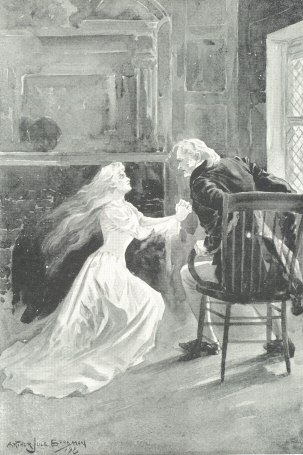
‘He had dismissed the governess by that time—whathe had left to do, he could best do alone—and they cameback, upon a rain night, to the scene of her longpreparation. She turned to him upon the threshold, as therain was dripping from the porch, and said:
‘“O sir, it is the Death-watch ticking forme!”
‘“Well!” he answered. “And if itwere?”
‘“O sir!” she returned to him, “lookkindly on me, and be merciful to me! I beg yourpardon. I will do anything you wish, if you will onlyforgive me!”
‘That had become the poor fool’s constant song:“I beg your pardon,” and “Forgiveme!”
‘She was not worth hating; he felt nothing but contemptfor her. But, she had long been in the way, and he had longbeen weary, and the work was near its end, and had to be workedout.
‘“You fool,” he said. “Go up thestairs!”
‘She obeyed very quickly, murmuring, “I will doanything you wish!” When he came into theBride’s Chamber, having been a little retarded by the heavyfastenings of the great door (for they were alone in the house,and he had arranged that the people who attended on them shouldcome and go in the day), he found her withdrawn to the furthestcorner, and there standing pressed against the paneling as if shewould have shrunk through it: her flaxen hair all wild about herface, and her large eyes staring at him in vague terror.
‘“What are you afraid of? Come and sit downby me.”
‘“I will do anything you wish. I beg yourpardon, sir. Forgive me!” Her monotonous tuneas usual.
‘“Ellen, here is a writing that you must write outto-morrow, in your own hand. You may as well be seen byothers, busily engaged upon it. When you have written itall fairly, and corrected all mistakes, call in any two peoplethere may be about the house, and sign your name to it beforethem. Then, put it in your bosom to keep it safe, and whenI sit here again to-morrow night, give it to me.”
‘“I will do it all, with the greatest care. I will do anything you wish.”
‘“Don’t shake and tremble, then.”
‘“I will try my utmost not to do it—if youwill only forgive me!”
‘Next day, she sat down at her desk, and did as she hadbeen told. He often passed in and out of the room, toobserve her, and always saw her slowly and laboriously writing:repeating to herself the words she copied, in appearance quitemechanically, and without caring or endeavouring to comprehendthem, so that she did her task. He saw her follow thedirections she had received, in all particulars; and at night,when they were alone again in the same Bride’s Chamber, andhe drew his chair to the hearth, she timidly approached him fromher distant seat, took the paper from her bosom, and gave it intohis hand.
‘It secured all her possessions to him, in the event ofher death. He put her before him, face to face, that hemight look at her steadily; and he asked her, in so many plainwords, neither fewer nor more, did she know that?
‘There were spots of ink upon the bosom of her whitedress, and they made her face look whiter and her eyes looklarger as she nodded her head. There were spots of ink uponthe hand with which she stood before him, nervously plaiting andfolding her white skirts.
‘He took her by the arm, and looked her, yet moreclosely and steadily, in the face. “Now, die! Ihave done with you.”
‘She shrunk, and uttered a low, suppressed cry.
‘“I am not going to kill you. I will notendanger my life for yours. Die!”
‘He sat before her in the gloomy Bride’s Chamber,day after day, night after night, looking the word at her when hedid not utter it. As often as her large unmeaning eyes wereraised from the hands in which she rocked her head, to the sternfigure, sitting with crossed arms and knitted forehead, in thechair, they read in it, “Die!” When she droppedasleep in exhaustion, she was called back to shudderingconsciousness, by the whisper, “Die!” When shefell upon her old entreaty to be pardoned, she was answered“Die!” When she had out-watched andout-suffered the long night, and the rising sun flamed into thesombre room, she heard it hailed with, “Another day and notdead?—Die!”
‘Shut up in the deserted mansion, aloof from allmankind, and engaged alone in such a struggle without anyrespite, it came to this—that either he must die, orshe. He knew it very well, and concentrated his strengthagainst her feebleness. Hours upon hours he held her by thearm when her arm was black where he held it, and bade herDie!
‘It was done, upon a windy morning, beforesunrise. He computed the time to be half-past four; but,his forgotten watch had run down, and he could not be sure. She had broken away from him in the night, with loud and suddencries—the first of that kind to which she had givenvent—and he had had to put his hands over her mouth. Since then, she had been quiet in the corner of the panelingwhere she had sunk down; and he had left her, and had gone backwith his folded arms and his knitted forehead to his chair.
‘Paler in the pale light, more colourless than ever inthe leaden dawn, he saw her coming, trailing herself along thefloor towards him—a white wreck of hair, and dress, andwild eyes, pushing itself on by an irresolute and bendinghand.
‘“O, forgive me! I will do anything. O, sir, pray tell me I may live!”
‘“Die!”
‘“Are you so resolved? Is there no hope forme?”
‘“Die!”
‘Her large eyes strained themselves with wonder andfear; wonder and fear changed to reproach; reproach to blanknothing. It was done. He was not at first so sure itwas done, but that the morning sun was hanging jewels in herhair—he saw the diamond, emerald, and ruby, glitteringamong it in little points, as he stood looking down ather—when he lifted her and laid her on her bed.
‘She was soon laid in the ground. And now theywere all gone, and he had compensated himself well.
‘He had a mind to travel. Not that he meant towaste his Money, for he was a pinching man and liked his Moneydearly (liked nothing else, indeed), but, that he had grown tiredof the desolate house and wished to turn his back upon it andhave done with it. But, the house was worth Money, andMoney must not be thrown away. He determined to sell itbefore he went. That it might look the less wretched andbring a better price, he hired some labourers to work in theovergrown garden; to cut out the dead wood, trim the ivy thatdrooped in heavy masses over the windows and gables, and clearthe walks in which the weeds were growing mid-leg high.
‘He worked, himself, along with them. He workedlater than they did, and, one evening at dusk, was left workingalone, with his bill-hook in his hand. One autumn evening,when the Bride was five weeks dead.
‘“It grows too dark to work longer,” he saidto himself, “I must give over for the night.”
‘He detested the house, and was loath to enter it. He looked at the dark porch waiting for him like a tomb, and feltthat it was an accursed house. Near to the porch, and nearto where he stood, was a tree whose branches waved before the oldbay-window of the Bride’s Chamber, where it had beendone. The tree swung suddenly, and made him start. Itswung again, although the night was still. Looking up intoit, he saw a figure among the branches.
‘It was the figure of a young man. The face lookeddown, as his looked up; the branches cracked and swayed; thefigure rapidly descended, and slid upon its feet beforehim. A slender youth of about her age, with long lightbrown hair.
‘“What thief are you?” he said, seizing theyouth by the collar.
‘The young man, in shaking himself free, swung him ablow with his arm across the face and throat. They closed,but the young man got from him and stepped back, crying, withgreat eagerness and horror, “Don’t touch me! Iwould as lieve be touched by the Devil!”
‘He stood still, with his bill-hook in his hand, lookingat the young man. For, the young man’s look was thecounterpart of her last look, and he had not expected ever to seethat again.
‘“I am no thief. Even if I were, I would nothave a coin of your wealth, if it would buy me the Indies. You murderer!”
‘“What!”
‘“I climbed it,” said the young man,pointing up into the tree, “for the first time, nigh fouryears ago. I climbed it, to look at her. I sawher. I spoke to her. I have climbed it, many a time,to watch and listen for her. I was a boy, hidden among itsleaves, when from that bay-window she gave me this!”
‘He showed a tress of flaxen hair, tied with a mourningribbon.
‘“Her life,” said the young man, “wasa life of mourning. She gave me this, as a token of it, anda sign that she was dead to every one but you. If I hadbeen older, if I had seen her sooner, I might have saved her fromyou. But, she was fast in the web when I first climbed thetree, and what could I do then to break it!”
‘In saying those words, he burst into a fit of sobbingand crying: weakly at first, then passionately.
‘“Murderer! I climbed the tree on the nightwhen you brought her back. I heard her, from the tree,speak of the Death-watch at the door. I was three times inthe tree while you were shut up with her, slowly killingher. I saw her, from the tree, lie dead upon her bed. I have watched you, from the tree, for proofs and traces of yourguilt. The manner of it, is a mystery to me yet, but I willpursue you until you have rendered up your life to thehangman. You shall never, until then, be rid of me. Iloved her! I can know no relenting towards you. Murderer, I loved her!”
‘The youth was bare-headed, his hat having flutteredaway in his descent from the tree. He moved towards thegate. He had to pass—Him—to get to it. There was breadth for two old-fashioned carriages abreast; andthe youth’s abhorrence, openly expressed in every featureof his face and limb of his body, and very hard to bear, hadverge enough to keep itself at a distance in. He (by whichI mean the other) had not stirred hand or foot, since he hadstood still to look at the boy. He faced round, now, tofollow him with his eyes. As the back of the barelight-brown head was turned to him, he saw a red curve stretchfrom his hand to it. He knew, before he threw thebill-hook, where it had alighted—I say, had alighted, andnot, would alight; for, to his clear perception the thing wasdone before he did it. It cleft the head, and it remainedthere, and the boy lay on his face.
‘He buried the body in the night, at the foot of thetree. As soon as it was light in the morning, he worked atturning up all the ground near the tree, and hacking and hewingat the neighbouring bushes and undergrowth. When thelabourers came, there was nothing suspicious, and nothingsuspected.
‘But, he had, in a moment, defeated all his precautions,and destroyed the triumph of the scheme he had so long concerted,and so successfully worked out. He had got rid of theBride, and had acquired her fortune without endangering his life;but now, for a death by which he had gained nothing, he hadevermore to live with a rope around his neck.
‘Beyond this, he was chained to the house of gloom andhorror, which he could not endure. Being afraid to sell itor to quit it, lest discovery should be made, he was forced tolive in it. He hired two old people, man and wife, for hisservants; and dwelt in it, and dreaded it. His greatdifficulty, for a long time, was the garden. Whether heshould keep it trim, whether he should suffer it to fall into itsformer state of neglect, what would be the least likely way ofattracting attention to it?
‘He took the middle course of gardening, himself, in hisevening leisure, and of then calling the old serving-man to helphim; but, of never letting him work there alone. And hemade himself an arbour over against the tree, where he could sitand see that it was safe.
‘As the seasons changed, and the tree changed, his mindperceived dangers that were always changing. In the leafytime, he perceived that the upper boughs were growing into theform of the young man—that they made the shape of himexactly, sitting in a forked branch swinging in the wind. In the time of the falling leaves, he perceived that they camedown from the tree, forming tell-tale letters on the path, orthat they had a tendency to heap themselves into a churchyardmound above the grave. In the winter, when the tree wasbare, he perceived that the boughs swung at him the ghost of theblow the young man had given, and that they threatened himopenly. In the spring, when the sap was mounting in thetrunk, he asked himself, were the dried-up particles of bloodmounting with it: to make out more obviously this year than last,the leaf-screened figure of the young man, swinging in thewind?
‘However, he turned his Money over and over, and stillover. He was in the dark trade, the gold-dust trade, andmost secret trades that yielded great returns. In tenyears, he had turned his Money over, so many times, that thetraders and shippers who had dealings with him, absolutely didnot lie—for once—when they declared that he hadincreased his fortune, Twelve Hundred Per Cent.
‘He possessed his riches one hundred years ago, whenpeople could be lost easily. He had heard who the youthwas, from hearing of the search that was made after him; but, itdied away, and the youth was forgotten.
‘The annual round of changes in the tree had beenrepeated ten times since the night of the burial at its foot,when there was a great thunder-storm over this place. Itbroke at midnight, and roared until morning. The firstintelligence he heard from his old serving-man that morning, was,that the tree had been struck by Lightning.
‘It had been riven down the stem, in a very surprisingmanner, and the stem lay in two blighted shafts: one restingagainst the house, and one against a portion of the old redgarden-wall in which its fall had made a gap. The fissurewent down the tree to a little above the earth, and therestopped. There was great curiosity to see the tree, and,with most of his former fears revived, he sat in hisarbour—grown quite an old man—watching the people whocame to see it.
‘They quickly began to come, in such dangerous numbers,that he closed his garden-gate and refused to admit anymore. But, there were certain men of science who travelledfrom a distance to examine the tree, and, in an evil hour, he letthem in!—Blight and Murrain on them, let them in!
‘They wanted to dig up the ruin by the roots, andclosely examine it, and the earth about it. Never, while helived! They offered money for it. They! Men ofscience, whom he could have bought by the gross, with a scratchof his pen! He showed them the garden-gate again, andlocked and barred it.
‘But they were bent on doing what they wanted to do, andthey bribed the old serving-man—a thankless wretch whoregularly complained when he received his wages, of beingunderpaid—and they stole into the garden by night withtheir lanterns, picks, and shovels, and fell to at thetree. He was lying in a turret-room on the other side ofthe house (the Bride’s Chamber had been unoccupied eversince), but he soon dreamed of picks and shovels, and got up.
‘He came to an upper window on that side, whence hecould see their lanterns, and them, and the loose earth in a heapwhich he had himself disturbed and put back, when it was lastturned to the air. It was found! They had that minutelighted on it. They were all bending over it. One ofthem said, “The skull is fractured;” and another,“See here the bones;” and another, “See herethe clothes;” and then the first struck in again, and said,“A rusty bill-hook!”
‘He became sensible, next day, that he was already putunder a strict watch, and that he could go nowhere without beingfollowed. Before a week was out, he was taken and laid inhold. The circumstances were gradually pieced togetheragainst him, with a desperate malignity, and an appallingingenuity. But, see the justice of men, and how it wasextended to him! He was further accused of having poisonedthat girl in the Bride’s Chamber. He, who hadcarefully and expressly avoided imperilling a hair of his headfor her, and who had seen her die of her own incapacity!
‘There was doubt for which of the two murders he shouldbe first tried; but, the real one was chosen, and he was foundGuilty, and cast for death. Bloodthirsty wretches! They would have made him Guilty of anything, so set they wereupon having his life.
‘His money could do nothing to save him, and he washanged. Iam He, and I was hanged at LancasterCastle with my face to the wall, a hundred years ago!’
At this terrific announcement, Mr. Goodchild tried to rise andcry out. But, the two fiery lines extending from the oldman’s eyes to his own, kept him down, and he could notutter a sound. His sense of hearing, however, was acute,and he could hear the clock strike Two. No sooner had heheard the clock strike Two, than he saw before him Two oldmen!
Two.
The eyes of each, connected with his eyes by two films offire: each, exactly like the other: each, addressing him atprecisely one and the same instant: each, gnashing the same teethin the same head, with the same twitched nostril above them, andthe same suffused expression around it. Two old men. Differing in nothing, equally distinct to the sight, the copy nofainter than the original, the second as real as the first.
‘At what time,’ said the Two old men, ‘didyou arrive at the door below?’
‘At Six.’
‘And there were Six old men upon the stairs!’
Mr. Goodchild having wiped the perspiration from his brow, ortried to do it, the Two old men proceeded in one voice, and inthe singular number:
‘I had been anatomised, but had not yet had my skeletonput together and re-hung on an iron hook, when it began to bewhispered that the Bride’s Chamber was haunted. Itwashaunted, and I was there.
‘Wewere there. She and I were there. I, in the chair upon the hearth; she, a white wreck again,trailing itself towards me on the floor. But, I was thespeaker no more, and the one word that she said to me frommidnight until dawn was, ‘Live!’
‘The youth was there, likewise. In the treeoutside the window. Coming and going in the moonlight, asthe tree bent and gave. He has, ever since, been there,peeping in at me in my torment; revealing to me by snatches, inthe pale lights and slatey shadows where he comes and goes,bare-headed—a bill-hook, standing edgewise in his hair.
‘In the Bride’s Chamber, every night from midnightuntil dawn—one month in the year excepted, as I am going totell you—he hides in the tree, and she comes towards me onthe floor; always approaching; never coming nearer; alwaysvisible as if by moon-light, whether the moon shines or no;always saying, from mid-night until dawn, her one word,“Live!”
‘But, in the month wherein I was forced out of thislife—this present month of thirty days—theBride’s Chamber is empty and quiet. Not so my olddungeon. Not so the rooms where I was restless and afraid,ten years. Both are fitfully haunted then. At One inthe morning. I am what you saw me when the clock struckthat hour—One old man. At Two in the morning, I amTwo old men. At Three, I am Three. By Twelve at noon,I am Twelve old men, One for every hundred per cent. of oldgain. Every one of the Twelve, with Twelve times my oldpower of suffering and agony. From that hour until Twelveat night, I, Twelve old men in anguish and fearful foreboding,wait for the coming of the executioner. At Twelve at night,I, Twelve old men turned off, swing invisible outside LancasterCastle, with Twelve faces to the wall!
‘When the Bride’s Chamber was first haunted, itwas known to me that this punishment would never cease, until Icould make its nature, and my story, known to two living mentogether. I waited for the coming of two living mentogether into the Bride’s Chamber, years upon years. It was infused into my knowledge (of the means I am ignorant)that if two living men, with their eyes open, could be in theBride’s Chamber at One in the morning, they would see mesitting in my chair.
‘At length, the whispers that the room was spirituallytroubled, brought two men to try the adventure. I wasscarcely struck upon the hearth at midnight (I come there as ifthe Lightning blasted me into being), when I heard them ascendingthe stairs. Next, I saw them enter. One of them was abold, gay, active man, in the prime of life, some five and fortyyears of age; the other, a dozen years younger. Theybrought provisions with them in a basket, and bottles. Ayoung woman accompanied them, with wood and coals for thelighting of the fire. When she had lighted it, the bold,gay, active man accompanied her along the gallery outside theroom, to see her safely down the staircase, and came backlaughing.
‘He locked the door, examined the chamber, put out thecontents of the basket on the table before the fire—littlerecking of me, in my appointed station on the hearth, close tohim—and filled the glasses, and ate and drank. Hiscompanion did the same, and was as cheerful and confident as he:though he was the leader. When they had supped, they laidpistols on the table, turned to the fire, and began to smoketheir pipes of foreign make.
‘They had travelled together, and had been muchtogether, and had an abundance of subjects in common. Inthe midst of their talking and laughing, the younger man made areference to the leader’s being always ready for anyadventure; that one, or any other. He replied in thesewords:
‘“Not quite so, Dick; if I am afraid of nothingelse, I am afraid of myself.”
‘His companion seeming to grow a little dull, asked him,in what sense? How?
‘“Why, thus,” he returned. “Hereis a Ghost to be disproved. Well! I cannot answer forwhat my fancy might do if I were alone here, or what tricks mysenses might play with me if they had me to themselves. But, in company with another man, and especially with Dick, Iwould consent to outface all the Ghosts that were ever of in theuniverse.”
‘“I had not the vanity to suppose that I was of somuch importance to-night,” said the other.
‘“Of so much,” rejoined the leader, moreseriously than he had spoken yet, “that I would, for thereason I have given, on no account have undertaken to pass thenight here alone.”
‘It was within a few minutes of One. The head ofthe younger man had drooped when he made his last remark, and itdrooped lower now.
‘“Keep awake, Dick!” said the leader,gaily. “The small hours are the worst.”
‘He tried, but his head drooped again.
‘“Dick!” urged the leader. “Keepawake!”
‘“I can’t,” he indistinctlymuttered. “I don’t know what strange influenceis stealing over me. I can’t.”
‘His companion looked at him with a sudden horror, andI, in my different way, felt a new horror also; for, it was onthe stroke of One, and I felt that the second watcher wasyielding to me, and that the curse was upon me that I must sendhim to sleep.
‘“Get up and walk, Dick!” cried theleader. “Try!”
‘It was in vain to go behind the slumber’s chairand shake him. One o’clock sounded, and I was presentto the elder man, and he stood transfixed before me.
‘To him alone, I was obliged to relate my story, withouthope of benefit. To him alone, I was an awful phantommaking a quite useless confession. I foresee it will everbe the same. The two living men together will never come torelease me. When I appear, the senses of one of the twowill be locked in sleep; he will neither see nor hear me; mycommunication will ever be made to a solitary listener, and willever be unserviceable. Woe! Woe! Woe!’
As the Two old men, with these words, wrung their hands, itshot into Mr. Goodchild’s mind that he was in the terriblesituation of being virtually alone with the spectre, and that Mr.Idle’s immoveability was explained by his having beencharmed asleep at One o’clock. In the terror of thissudden discovery which produced an indescribable dread, hestruggled so hard to get free from the four fiery threads, thathe snapped them, after he had pulled them out to a greatwidth. Being then out of bonds, he caught up Mr. Idle fromthe sofa and rushed down-stairs with him.
‘What are you about, Francis?’ demanded Mr.Idle. ‘My bedroom is not down here. What thedeuce are you carrying me at all for? I can walk with astick now. I don’t want to be carried. Put medown.’
Mr. Goodchild put him down in the old hall, and looked abouthim wildly.
‘What are you doing? Idiotically plunging at yourown sex, and rescuing them or perishing in the attempt?’asked Mr. Idle, in a highly petulant state.
‘The One old man!’ cried Mr. Goodchild,distractedly,—‘and the Two old men!’
Mr. Idle deigned no other reply than ‘The One old woman,I think you mean,’ as he began hobbling his way back up thestaircase, with the assistance of its broad balustrade.
‘I assure you, Tom,’ began Mr. Goodchild,attending at his side, ‘that since you fellasleep—’
‘Come, I like that!’ said Thomas Idle, ‘Ihaven’t closed an eye!’
With the peculiar sensitiveness on the subject of thedisgraceful action of going to sleep out of bed, which is the lotof all mankind, Mr. Idle persisted in this declaration. Thesame peculiar sensitiveness impelled Mr. Goodchild, on beingtaxed with the same crime, to repudiate it with honourableresentment. The settlement of the question of The One oldman and The Two old men was thus presently complicated, and soonmade quite impracticable. Mr. Idle said it was allBride-cake, and fragments, newly arranged, of things seen andthought about in the day. Mr. Goodchild said how could thatbe, when he hadn’t been asleep, and what right could Mr.Idle have to say so, who had been asleep? Mr. Idle said hehad never been asleep, and never did go to sleep, and that Mr.Goodchild, as a general rule, was always asleep. Theyconsequently parted for the rest of the night, at their bedroomdoors, a little ruffled. Mr. Goodchild’s last wordswere, that he had had, in that real and tangible old sitting-roomof that real and tangible old Inn (he supposed Mr. Idle deniedits existence?), every sensation and experience, the presentrecord of which is now within a line or two of completion; andthat he would write it out and print it every word. Mr.Idle returned that he might if he liked—and he did like,and has now done it.
CHAPTER V
Two of the many passengers by acertain late Sunday evening train, Mr. Thomas Idle and Mr.Francis Goodchild, yielded up their tickets at a little rottenplatform (converted into artificial touchwood by smoke andashes), deep in the manufacturing bosom of Yorkshire. Amysterious bosom it appeared, upon a damp, dark, Sunday night,dashed through in the train to the music of the whirling wheels,the panting of the engine, and the part-singing of hundreds ofthird-class excursionists, whose vocal efforts ‘bobbedarayound’ from sacred to profane, from hymns, to ourtransatlantic sisters the Yankee Gal and Mairy Anne, in aremarkable way. There seemed to have been some large vocalgathering near to every lonely station on the line. No townwas visible, no village was visible, no light was visible; but, amultitude got out singing, and a multitude got in singing, andthe second multitude took up the hymns, and adopted ourtransatlantic sisters, and sang of their own egregiouswickedness, and of their bobbing arayound, and of how the ship itwas ready and the wind it was fair, and they were bayound for thesea, Mairy Anne, until they in their turn became a getting-outmultitude, and were replaced by another getting-in multitude, whodid the same. And at every station, the getting-inmultitude, with an artistic reference to the completeness oftheir chorus, incessantly cried, as with one voice whilescuffling into the carriages, ‘We mun aa’ gangtoogither!’
The singing and the multitudes had trailed off as the lonelyplaces were left and the great towns were neared, and the way hadlain as silently as a train’s way ever can, over the vagueblack streets of the great gulfs of towns, and among theirbranchless woods of vague black chimneys. These townslooked, in the cinderous wet, as though they had one and all beenon fire and were just put out—a dreary and quenchedpanorama, many miles long.
Thus, Thomas and Francis got to Leeds; of which enterprisingand important commercial centre it may be observed with delicacy,that you must either like it very much or not at all. Nextday, the first of the Race-Week, they took train toDoncaster.
And instantly the character, both of travellers and ofluggage, entirely changed, and no other business thanrace-business any longer existed on the face of the earth. The talk was all of horses and ‘John Scott.’ Guards whispered behind their hands to station-masters, of horsesand John Scott. Men in cut-away coats and speckled cravatsfastened with peculiar pins, and with the large bones of theirlegs developed under tight trousers, so that they should look asmuch as possible like horses’ legs, paced up and down bytwos at junction-stations, speaking low and moodily of horses andJohn Scott. The young clergyman in the blackstrait-waistcoat, who occupied the middle seat of the carriage,expounded in his peculiar pulpit-accent to the young and lovelyReverend Mrs. Crinoline, who occupied the opposite middle-seat, afew passages of rumour relative to ‘Oartheth, my love, andMithter John Eth-COTT.’ A bandy vagabond, with a head like a Dutch cheese, in a fustianstable-suit, attending on a horse-box and going about theplatforms with a halter hanging round his neck like a Calaisburgher of the ancient period much degenerated, was courted bythe best society, by reason of what he had to hint, when notengaged in eating straw, concerning ‘t’harses andJoon Scott.’ The engine-driver himself, as he appliedone eye to his large stationary double-eye-glass on the engine,seemed to keep the other open, sideways, upon horses and JohnScott.
Breaks and barriers at Doncaster Station to keep the crowdoff; temporary wooden avenues of ingress and egress, to help thecrowd on. Forty extra porters sent down for this presentblessed Race-Week, and all of them making up their betting-booksin the lamp-room or somewhere else, and none of them to come andtouch the luggage. Travellers disgorged into an open space,a howling wilderness of idle men. All work but race-work ata stand-still; all men at a stand-still. ‘Ey myword! Deant ask noon o’ us to help wi’t’luggage. Bock your opinion loike a mon. Coom! Dang it, coom, t’harses and JoonScott!’ In the midst of the idle men, all the flyhorses and omnibus horses of Doncaster and parts adjacent,rampant, rearing, backing, plunging, shying—apparently theresult of their hearing of nothing but their own order and JohnScott.
Grand Dramatic Company from London for the Race-Week. Poses Plastiques in the Grand Assembly Room up the Stable-Yard atseven and nine each evening, for the Race-Week. GrandAlliance Circus in the field beyond the bridge, for theRace-Week. Grand Exhibition of Aztec Lilliputians,important to all who want to be horrified cheap, for theRace-Week. Lodgings, grand and not grand, but all at grandprices, ranging from ten pounds to twenty, for the GrandRace-Week!
Rendered giddy enough by these things, Messieurs Idle andGoodchild repaired to the quarters they had secured beforehand,and Mr. Goodchild looked down from the window into the surgingstreet.
‘By Heaven, Tom!’ cried he, after contemplatingit, ‘I am in the Lunatic Asylum again, and these are allmad people under the charge of a body of designingkeepers!’
All through the Race-Week, Mr. Goodchild never divestedhimself of this idea. Every day he looked out of window,with something of the dread of Lemuel Gulliver looking down atmen after he returned home from the horse-country; and every dayhe saw the Lunatics, horse-mad, betting-mad, drunken-mad,vice-mad, and the designing Keepers always after them. Theidea pervaded, like the second colour in shot-silk, the whole ofMr. Goodchild’s impressions. They were much asfollows:
Monday, mid-day. Races not to begin until to-morrow, butall the mob-Lunatics out, crowding the pavements of the one mainstreet of pretty and pleasant Doncaster, crowding the road,particularly crowding the outside of the Betting Rooms, whoopingand shouting loudly after all passing vehicles. Frightenedlunatic horses occasionally running away, with infiniteclatter. All degrees of men, from peers to paupers, bettingincessantly. Keepers very watchful, and taking all goodchances. An awful family likeness among the Keepers, to Mr.Palmer and Mr. Thurtell. With some knowledge of expressionand some acquaintance with heads (thus writes Mr. Goodchild), Inever have seen anywhere, so many repetitions of one class ofcountenance and one character of head (both evil) as in thisstreet at this time. Cunning, covetousness, secrecy, coldcalculation, hard callousness and dire insensibility, are theuniform Keeper characteristics. Mr. Palmer passes me fivetimes in five minutes, and, so I go down the street, the back ofMr. Thurtell’s skull is always going on before me.
Monday evening. Town lighted up; more Lunatics out thanever; a complete choke and stoppage of the thoroughfare outsidethe Betting Rooms. Keepers, having dined, pervade theBetting Rooms, and sharply snap at the moneyed Lunatics. Some Keepers flushed with drink, and some not, but all close andcalculating. A vague echoing roar of‘t’harses’ and ‘t’races’always rising in the air, until midnight, at about which periodit dies away in occasional drunken songs and stragglingyells. But, all night, some unmannerly drinking-house inthe neighbourhood opens its mouth at intervals and spits out aman too drunk to be retained: who thereupon makes what uproariousprotest may be left in him, and either falls asleep where hetumbles, or is carried off in custody.
Tuesday morning, at daybreak. A sudden rising, as itwere out of the earth, of all the obscene creatures, who sell‘correct cards of the races.’ They may havebeen coiled in corners, or sleeping on door-steps, and, havingall passed the night under the same set of circumstances, may allwant to circulate their blood at the same time; but, however thatmay be, they spring into existence all at once and together, asthough a new Cadmus had sown a race-horse’s teeth. There is nobody up, to buy the cards; but, the cards are madlycried. There is no patronage to quarrel for; but, theymadly quarrel and fight. Conspicuous among thesehyænas, as breakfast-time discloses, is a fearful creaturein the general semblance of a man: shaken off his next-to-no legsby drink and devilry, bare-headed and bare-footed, with a greatshock of hair like a horrible broom, and nothing on him but aragged pair of trousers and a pink glazed-calico coat—madeon him—so very tight that it is as evident that he couldnever take it off, as that he never does. This hideousapparition, inconceivably drunk, has a terrible power of making agong-like imitation of the braying of an ass: which feat requiresthat he should lay his right jaw in his begrimed right paw,double himself up, and shake his bray out of himself, with muchstaggering on his next-to-no legs, and much twirling of hishorrible broom, as if it were a mop. From the presentminute, when he comes in sight holding up his cards to thewindows, and hoarsely proposing purchase to My Lord, YourExcellency, Colonel, the Noble Captain, and Your HonourableWorship—from the present minute until the Grand Race-Weekis finished, at all hours of the morning, evening, day, andnight, shall the town reverberate, at capricious intervals, tothe brays of this frightful animal the Gong-donkey.
No very great racing to-day, so no very great amount ofvehicles: though there is a good sprinkling, too: fromfarmers’ carts and gigs, to carriages with post-horses andto fours-in-hand, mostly coming by the road from York, andpassing on straight through the main street to the Course. A walk in the wrong direction may be a better thing for Mr.Goodchild to-day than the Course, so he walks in the wrongdirection. Everybody gone to the races. Only childrenin the street. Grand Alliance Circus deserted; not oneStar-Rider left; omnibus which forms the Pay-Place, having onseparate panels Pay here for the Boxes, Pay here for the Pit, Payhere for the Gallery, hove down in a corner and locked up; nobodynear the tent but the man on his knees on the grass, who ismaking the paper balloons for the Star young gentlemen to jumpthrough to-night. A pleasant road, pleasantly wooded. No labourers working in the fields; all gone‘t’races.’ The few late wenders of theirway ‘t’races,’ who are yet left driving on theroad, stare in amazement at the recluse who is not going‘t’races.’ Roadside innkeeper has gone‘t’races.’ Turnpike-man has gone‘t’races.’ His thrifty wife, washingclothes at the toll-house door, is going‘t’races’ to-morrow. Perhaps there may beno one left to take the toll to-morrow; who knows? Thoughassuredly that would be neither turnpike-like norYorkshire-like. The very wind and dust seem to be hurrying‘t’races,’ as they briskly pass the onlywayfarer on the road. In the distance, the Railway Engine,waiting at the town-end, shrieks despairingly. Nothing butthe difficulty of getting off the Line, restrains that Enginefrom going ‘t’races,’ too, it is veryclear.
At night, more Lunatics out than last night—and moreKeepers. The latter very active at the Betting Rooms, thestreet in front of which is now impassable. Mr. Palmer asbefore. Mr. Thurtell as before. Roar and uproar asbefore. Gradual subsidence as before. Unmannerlydrinking-house expectorates as before. Drunkennegro-melodists, Gong-donkey, and correct cards, in thenight.
On Wednesday morning, the morning of the great St. Leger, itbecomes apparent that there has been a great influx sinceyesterday, both of Lunatics and Keepers. The families ofthe tradesmen over the way are no longer within human ken; theirplaces know them no more; ten, fifteen, and twenty guinea-lodgersfill them. At the pastry-cook’s second-floor window,a Keeper is brushing Mr. Thurtell’s hair—thinking ithis own. In the wax-chandler’s attic, another Keeperis putting on Mr. Palmer’s braces. In thegunsmith’s nursery, a Lunatic is shaving himself. Inthe serious stationer’s best sitting-room, three Lunaticsare taking a combination-breakfast, praising the (cook’s)devil, and drinking neat brandy in an atmosphere of lastmidnight’s cigars. No family sanctuary is free fromour Angelic messengers—we put up at the Angel—who inthe guise of extra waiters for the grand Race-Week, rattle in andout of the most secret chambers of everybody’s house, withdishes and tin covers, decanters, soda-water bottles, andglasses. An hour later. Down the street and up thestreet, as far as eyes can see and a good deal farther, there isa dense crowd; outside the Betting Rooms it is like a greatstruggle at a theatre door—in the days of theatres; or atthe vestibule of the Spurgeon temple—in the days ofSpurgeon. An hour later. Fusing into this crowd, andsomehow getting through it, are all kinds of conveyances, and allkinds of foot-passengers; carts, with brick-makers andbrick-makeresses jolting up and down on planks; drags, with theneedful grooms behind, sitting cross-armed in the needful manner,and slanting themselves backward from the soles of their boots atthe needful angle; postboys, in the shining hats and smartjackets of the olden time, when stokers were not; beautifulYorkshire horses, gallantly driven by their own breeders andmasters. Under every pole, and every shaft, and everyhorse, and every wheel as it would seem, theGong-donkey—metallically braying, when not struggling forlife, or whipped out of the way.
By one o’clock, all this stir has gone out of thestreets, and there is no one left in them but FrancisGoodchild. Francis Goodchild will not be left in them long;for, he too is on his way, ‘t’races.’
A most beautiful sight, Francis Goodchild finds‘t’races’ to be, when he has left fairDoncaster behind him, and comes out on the free course, with itsagreeable prospect, its quaint Red House oddly changing andturning as Francis turns, its green grass, and fresh heath. A free course and an easy one, where Francis can roll smoothlywhere he will, and can choose between the start, or thecoming-in, or the turn behind the brow of the hill, or anyout-of-the-way point where he lists to see the throbbing horsesstraining every nerve, and making the sympathetic earth throb asthey come by. Francis much delights to be, not in the GrandStand, but where he can see it, rising against the sky with itsvast tiers of little white dots of faces, and its last high rowsand corners of people, looking like pins stuck into an enormouspincushion—not quite so symmetrically as his orderly eyecould wish, when people change or go away. When the race isnearly run out, it is as good as the race to him to see theflutter among the pins, and the change in them from dark tolight, as hats are taken off and waved. Not less full ofinterest, the loud anticipation of the winner’s name, theswelling, and the final, roar; then, the quick dropping of allthe pins out of their places, the revelation of the shape of thebare pincushion, and the closing-in of the whole host of Lunaticsand Keepers, in the rear of the three horses with bright-colouredriders, who have not yet quite subdued their gallop though thecontest is over.
Mr. Goodchild would appear to have been by no means free fromlunacy himself at ‘t’races,’ though not of theprevalent kind. He is suspected by Mr. Idle to have falleninto a dreadful state concerning a pair of little lilac glovesand a little bonnet that he saw there. Mr. Idle asserts,that he did afterwards repeat at the Angel, with an appearance ofbeing lunatically seized, some rhapsody to the following effect:‘O little lilac gloves! And O winning little bonnet,making in conjunction with her golden hair quite a Glory in thesunlight round the pretty head, why anything in the world but youand me! Why may not this day’s running-of horses, toall the rest: of precious sands of life to me—be prolongedthrough an everlasting autumn-sunshine, without a sunset! Slave of the Lamp, or Ring, strike me yonder gallant equestrianClerk of the Course, in the scarlet coat, motionless on the greengrass for ages! Friendly Devil on Two Sticks, for ten timesten thousands years, keep Blink-Bonny jibbing at the post, andlet us have no start! Arab drums, powerful of old to summonGenii in the desert, sound of yourselves and raise a troop for mein the desert of my heart, which shall so enchant this dustybarouche (with a conspicuous excise-plate, resembling theCollector’s door-plate at a turnpike), that I, within it,loving the little lilac gloves, the winning little bonnet, andthe dear unknown-wearer with the golden hair, may wait by herside for ever, to see a Great St. Leger that shall never berun!’
Thursday morning. After a tremendous night of crowding,shouting, drinking-house expectoration, Gong-donkey, and correctcards. Symptoms of yesterday’s gains in the way ofdrink, and of yesterday’s losses in the way of money,abundant. Money-losses very great. As usual, nobodyseems to have won; but, large losses and many losers areunquestionable facts. Both Lunatics and Keepers, in generalvery low. Several of both kinds look in at thechemist’s while Mr. Goodchild is making a purchase there,to be ‘picked up.’ One red-eyed Lunatic,flushed, faded, and disordered, enters hurriedly and criessavagely, ‘Hond us a gloss of sal volatile in wather, orsoom dommed thing o’ thot sart!’ Faces at theBetting Rooms very long, and a tendency to bite nailsobservable. Keepers likewise given this morning to standingabout solitary, with their hands in their pockets, looking downat their boots as they fit them into cracks of the pavement, andthen looking up whistling and walking away. Grand AllianceCircus out, in procession; buxom lady-member of Grand Alliance,in crimson riding-habit, fresher to look at, even in her paintunder the day sky, than the cheeks of Lunatics or Keepers. Spanish Cavalier appears to have lost yesterday, and jingles hisbossed bridle with disgust, as if he were paying. Reactionalso apparent at the Guildhall opposite, whence certainpickpockets come out handcuffed together, with that peculiar walkwhich is never seen under any other circumstances—a walkexpressive of going to jail, game, but still of jails being inbad taste and arbitrary, and how would youlike it if itwas you instead of me, as it ought to be! Mid-day. Town filled as yesterday, but not so full; and emptied asyesterday, but not so empty. In the evening, Angel ordinarywhere every Lunatic and Keeper has his modest daily meal ofturtle, venison, and wine, not so crowded as yesterday, and notso noisy. At night, the theatre. More abstractedfaces in it than one ever sees at public assemblies; such faceswearing an expression which strongly reminds Mr. Goodchild of theboys at school who were ‘going up next,’ with theirarithmetic or mathematics. These boys are, no doubt, goingup to-morrow with theirsums and figures. Mr. Palmerand Mr. Thurtell in the boxes O. P. Mr. Thurtell and Mr.Palmer in the boxes P. S. The firm of Thurtell, Palmer, andThurtell, in the boxes Centre. A most odious tendencyobservable in these distinguished gentlemen to put vileconstructions on sufficiently innocent phrases in the play, andthen to applaud them in a Satyr-like manner. Behind Mr.Goodchild, with a party of other Lunatics and one Keeper, theexpress incarnation of the thing called a‘gent.’ A gentleman born; a gentmanufactured. A something with a scarf round its neck, anda slipshod speech issuing from behind the scarf; more depraved,more foolish, more ignorant, more unable to believe in any nobleor good thing of any kind, than the stupidest Bosjesman. The thing is but a boy in years, and is addled with drink. To do its company justice, even its company is ashamed of it, asit drawls its slang criticisms on the representation, andinflames Mr. Goodchild with a burning ardour to fling it into thepit. Its remarks are so horrible, that Mr. Goodchild, forthe moment, even doubts whether that isa wholesome Art,which sets women apart on a high floor before such a thing asthis, though as good as its own sisters, or its ownmother—whom Heaven forgive for bringing it into theworld! But, the consideration that a low nature must make alow world of its own to live in, whatever the real materials, orit could no more exist than any of us could without the sense oftouch, brings Mr. Goodchild to reason: the rather, because thething soon drops its downy chin upon its scarf, and slobbersitself asleep.
Friday Morning. Early fights. Gong-donkey, andcorrect cards. Again, a great set towards the races, thoughnot so great a set as on Wednesday. Much packing going ontoo, upstairs at the gun-smith’s, the wax-chandler’s,and the serious stationer’s; for there will be a heavydrift of Lunatics and Keepers to London by the afternoontrain. The course as pretty as ever; the great pincushionas like a pincushion, but not nearly so full of pins; whole rowsof pins wanting. On the great event of the day, bothLunatics and Keepers become inspired with rage; and there is aviolent scuffling, and a rushing at the losing jockey, and anemergence of the said jockey from a swaying and menacing crowd,protected by friends, and looking the worse for wear; which is arough proceeding, though animating to see from a pleasantdistance. After the great event, rills begin to flow fromthe pincushion towards the railroad; the rills swell into rivers;the rivers soon unite into a lake. The lake floats Mr.Goodchild into Doncaster, past the Itinerant personage in black,by the way-side telling him from the vantage ground of a legiblyprinted placard on a pole that for all these things the Lord willbring him to judgment. No turtle and venison ordinary thisevening; that is all over. No Betting at the rooms; nothingthere but the plants in pots, which have, all the week, beenstood about the entry to give it an innocent appearance, andwhich have sorely sickened by this time.
Saturday. Mr. Idle wishes to know at breakfast, whatwere those dreadful groanings in his bedroom doorway in thenight? Mr. Goodchild answers, Nightmare. Mr. Idlerepels the calumny, and calls the waiter. The Angel is verysorry—had intended to explain; but you see, gentlemen,there was a gentleman dined down-stairs with two more, and he hadlost a deal of money, and he would drink a deal of wine, and inthe night he ‘took the horrors,’ and got up; and ashis friends could do nothing with him he laid himself down andgroaned at Mr. Idle’s door. ‘And he DID groan there,’ Mr. Idle says;‘and you will please to imagine me inside, “takingthe horrors” too!’
So far, the picture of Doncaster on the occasion of its greatsporting anniversary, offers probably a general representation ofthe social condition of the town, in the past as well as in thepresent time. The sole local phenomenon of the currentyear, which may be considered as entirely unprecedented in itsway, and which certainly claims, on that account, some slightshare of notice, consists in the actual existence of oneremarkable individual, who is sojourning in Doncaster, and who,neither directly nor indirectly, has anything at all to do, inany capacity whatever, with the racing amusements of theweek. Ranging throughout the entire crowd that fills thetown, and including the inhabitants as well as the visitors,nobody is to be found altogether disconnected with the businessof the day, excepting this one unparalleled man. He doesnot bet on the races, like the sporting men. He does notassist the races, like the jockeys, starters, judges, andgrooms. He does not look on at the races, like Mr.Goodchild and his fellow-spectators. He does not profit bythe races, like the hotel-keepers and the tradespeople. Hedoes not minister to the necessities of the races, like thebooth-keepers, the postilions, the waiters, and the hawkers ofLists. He does not assist the attractions of the races,like the actors at the theatre, the riders at the circus, or theposturers at the Poses Plastiques. Absolutely andliterally, he is the only individual in Doncaster who stands bythe brink of the full-flowing race-stream, and is not swept awayby it in common with all the rest of his species. Who isthis modern hermit, this recluse of the St. Leger-week, thisinscrutably ungregarious being, who lives apart from theamusements and activities of his fellow-creatures? Surely,there is little difficulty in guessing that clearest and easiestof all riddles. Who could he be, but Mr. Thomas Idle?
Thomas had suffered himself to be taken to Doncaster, just ashe would have suffered himself to be taken to any other place inthe habitable globe which would guarantee him the temporarypossession of a comfortable sofa to rest his ankle on. Onceestablished at the hotel, with his leg on one cushion and hisback against another, he formally declined taking the slightestinterest in any circumstance whatever connected with the races,or with the people who were assembled to see them. FrancisGoodchild, anxious that the hours should pass by his crippledtravelling-companion as lightly as possible, suggested that hissofa should be moved to the window, and that he should amusehimself by looking out at the moving panorama of humanity, whichthe view from it of the principal street presented. Thomas,however, steadily declined profiting by the suggestion.
‘The farther I am from the window,’ he said,‘the better, Brother Francis, I shall be pleased. Ihave nothing in common with the one prevalent idea of all thosepeople who are passing in the street. Why should I care tolook at them?’
‘I hope I have nothing in common with the prevalent ideaof a great many of them, either,’ answered Goodchild,thinking of the sporting gentlemen whom he had met in the courseof his wanderings about Doncaster. ‘But, surely,among all the people who are walking by the house, at this verymoment, you may find—’
‘Not one living creature,’ interposed Thomas,‘who is not, in one way or another, interested in horses,and who is not, in a greater or less degree, an admirer ofthem. Now, I hold opinions in reference to these particularmembers of the quadruped creation, which may lay claim (as Ibelieve) to the disastrous distinction of being unpartaken by anyother human being, civilised or savage, over the whole surface ofthe earth. Taking the horse as an animal in the abstract,Francis, I cordially despise him from every point ofview.’
‘Thomas,’ said Goodchild, ‘confinement tothe house has begun to affect your biliary secretions. Ishall go to the chemist’s and get you somephysic.’
‘I object,’ continued Thomas, quietly possessinghimself of his friend’s hat, which stood on a table nearhim,—‘I object, first, to the personal appearance ofthe horse. I protest against the conventional idea ofbeauty, as attached to that animal. I think his nose toolong, his forehead too low, and his legs (except in the case ofthe cart-horse) ridiculously thin by comparison with the size ofhis body. Again, considering how big an animal he is, Iobject to the contemptible delicacy of his constitution. Ishe not the sickliest creature in creation? Does any childcatch cold as easily as a horse? Does he not sprain hisfetlock, for all his appearance of superior strength, as easilyas I sprained my ankle! Furthermore, to take him fromanother point of view, what a helpless wretch he is! Nofine lady requires more constant waiting-on than a horse. Other animals can make their own toilette: he must have agroom. You will tell me that this is because we want tomake his coat artificially glossy. Glossy! Come homewith me, and see my cat,—my clever cat, who can groomherself! Look at your own dog! see how the intelligentcreature curry-combs himself with his own honest teeth! Then, again, what a fool the horse is, what a poor, nervousfool! He will start at a piece of white paper in the roadas if it was a lion. His one idea, when he hears a noisethat he is not accustomed to, is to run away from it. Whatdo you say to those two common instances of the sense and courageof this absurdly overpraised animal? I might multiply themto two hundred, if I chose to exert my mind and waste my breath,which I never do. I prefer coming at once to my last chargeagainst the horse, which is the most serious of all, because itaffects his moral character. I accuse him boldly, in hiscapacity of servant to man, of slyness and treachery. Ibrand him publicly, no matter how mild he may look about theeyes, or how sleek he may be about the coat, as a systematicbetrayer, whenever he can get the chance, of the confidencereposed in him. What do you mean by laughing and shakingyour head at me?’
‘Oh, Thomas, Thomas!’ said Goodchild. ‘You had better give me my hat; you had better let me getyou that physic.’
‘I will let you get anything you like, including acomposing draught for yourself,’ said Thomas, irritablyalluding to his fellow-apprentice’s inexhaustible activity,‘if you will only sit quiet for five minutes longer, andhear me out. I say again the horse is a betrayer of theconfidence reposed in him; and that opinion, let me add, is drawnfrom my own personal experience, and is not based on any fancifultheory whatever. You shall have two instances, twooverwhelming instances. Let me start the first of these byasking, what is the distinguishing quality which the ShetlandPony has arrogated to himself, and is still perpetuallytrumpeting through the world by means of popular report and bookson Natural History? I see the answer in your face: it isthe quality of being Sure-Footed. He professes to haveother virtues, such as hardiness and strength, which you maydiscover on trial; but the one thing which he insists on yourbelieving, when you get on his back, is that he may be safelydepended on not to tumble down with you. Very good. Some years ago, I was in Shetland with a party of friends. They insisted on taking me with them to the top of a precipicethat overhung the sea. It was a great distance off, butthey all determined to walk to it except me. I was wiserthen than I was with you at Carrock, and I determined to becarried to the precipice. There was no carriage-road in theisland, and nobody offered (in consequence, as I suppose, of theimperfectly-civilised state of the country) to bring me asedan-chair, which is naturally what I should have likedbest. A Shetland pony was produced instead. Iremembered my Natural History, I recalled popular report, and Igot on the little beast’s back, as any other man would havedone in my position, placing implicit confidence in the surenessof his feet. And how did he repay that confidence? Brother Francis, carry your mind on from morning to noon. Picture to yourself a howling wilderness of grass and bog,bounded by low stony hills. Pick out one particular spot inthat imaginary scene, and sketch me in it, with outstretchedarms, curved back, and heels in the air, plunging headforemostinto a black patch of water and mud. Place just behind methe legs, the body, and the head of a sure-footed Shetland pony,all stretched flat on the ground, and you will have produced anaccurate representation of a very lamentable fact. And themoral device, Francis, of this picture will be to testify thatwhen gentlemen put confidence in the legs of Shetland ponies,they will find to their cost that they are leaning on nothing butbroken reeds. There is my first instance—and whathave you got to say to that?’
‘Nothing, but that I want my hat,’ answeredGoodchild, starting up and walking restlessly about the room.
‘You shall have it in a minute,’ rejoinedThomas. ‘My second instance’—(Goodchildgroaned, and sat down again)—‘My second instance ismore appropriate to the present time and place, for it refers toa race-horse. Two years ago an excellent friend of mine,who was desirous of prevailing on me to take regular exercise,and who was well enough acquainted with the weakness of my legsto expect no very active compliance with his wishes on theirpart, offered to make me a present of one of his horses. Hearing that the animal in question had started in life on theturf, I declined accepting the gift with many thanks; adding, byway of explanation, that I looked on a race-horse as a kind ofembodied hurricane, upon which no sane man of my character andhabits could be expected to seat himself. My friend repliedthat, however appropriate my metaphor might be as applied torace-horses in general, it was singularly unsuitable as appliedto the particular horse which he proposed to give me. Froma foal upwards this remarkable animal had been the idlest andmost sluggish of his race. Whatever capacities for speed hemight possess he had kept so strictly to himself, that no amountof training had ever brought them out. He had been foundhopelessly slow as a racer, and hopelessly lazy as a hunter, andwas fit for nothing but a quiet, easy life of it with an oldgentleman or an invalid. When I heard this account of thehorse, I don’t mind confessing that my heart warmed tohim. Visions of Thomas Idle ambling serenely on the back ofa steed as lazy as himself, presenting to a restless world thesoothing and composite spectacle of a kind of sluggardly Centaur,too peaceable in his habits to alarm anybody, swam attractivelybefore my eyes. I went to look at the horse in thestable. Nice fellow! he was fast asleep with a kitten onhis back. I saw him taken out for an airing by thegroom. If he had had trousers on his legs I should not haveknown them from my own, so deliberately were they lifted up, sogently were they put down, so slowly did they get over theground. From that moment I gratefully accepted myfriend’s offer. I went home; the horse followedme—by a slow train. Oh, Francis, how devoutly Ibelieved in that horse I how carefully I looked after all hislittle comforts! I had never gone the length of hiring aman-servant to wait on myself; but I went to the expense ofhiring one to wait upon him. If I thought a little ofmyself when I bought the softest saddle that could be had formoney, I thought also of my horse. When the man at the shopafterwards offered me spurs and a whip, I turned from him withhorror. When I sallied out for my first ride, I wentpurposely unarmed with the means of hurrying my steed. Heproceeded at his own pace every step of the way; and when hestopped, at last, and blew out both his sides with a heavy sigh,and turned his sleepy head and looked behind him, I took him homeagain, as I might take home an artless child who said to me,“If you please, sir, I am tired.” For a weekthis complete harmony between me and my horse lastedundisturbed. At the end of that time, when he had madequite sure of my friendly confidence in his laziness, when he hadthoroughly acquainted himself with all the little weaknesses ofmy seat (and their name is Legion), the smouldering treachery andingratitude of the equine nature blazed out in an instant. Without the slightest provocation from me, with nothing passinghim at the time but a pony-chaise driven by an old lady, hestarted in one instant from a state of sluggish depression to astate of frantic high spirits. He kicked, he plunged, heshied, he pranced, he capered fearfully. I sat on him aslong as I could, and when I could sit no longer, I felloff. No, Francis! this is not a circumstance to be laughedat, but to be wept over. What would be said of a Man whohad requited my kindness in that way? Range over all therest of the animal creation, and where will you find me aninstance of treachery so black as this? The cow that kicksdown the milking-pail may have some reason for it; she may thinkherself taxed too heavily to contribute to the dilution of humantea and the greasing of human bread. The tiger who springsout on me unawares has the excuse of being hungry at the time, tosay nothing of the further justification of being a totalstranger to me. The very flea who surprises me in my sleepmay defend his act of assassination on the ground that I, in myturn, am always ready to murder him when I am awake. I defythe whole body of Natural Historians to move me, logically, offthe ground that I have taken in regard to the horse. Receive back your hat, Brother Francis, and go to thechemist’s, if you please; for I have now done. Ask meto take anything you like, except an interest in the Doncasterraces. Ask me to look at anything you like, except anassemblage of people all animated by feelings of a friendly andadmiring nature towards the horse. You are a remarkablywell-informed man, and you have heard of hermits. Look uponme as a member of that ancient fraternity, and you will sensiblyadd to the many obligations which Thomas Idle is proud to owe toFrancis Goodchild.’
Here, fatigued by the effort of excessive talking,disputatious Thomas waved one hand languidly, laid his head backon the sofa-pillow, and calmly closed his eyes.
At a later period, Mr. Goodchild assailed his travellingcompanion boldly from the impregnable fortress of commonsense. But Thomas, though tamed in body by drasticdiscipline, was still as mentally unapproachable as ever on thesubject of his favourite delusion.
The view from the window after Saturday’s breakfast isaltogether changed. The tradesmen’s families have allcome back again. The serious stationer’s young womanof all work is shaking a duster out of the window of thecombination breakfast-room; a child is playing with a doll, whereMr. Thurtell’s hair was brushed; a sanitary scrubbing is inprogress on the spot where Mr. Palmer’s braces were puton. No signs of the Races are in the streets, but thetramps and the tumble-down-carts and trucks laden withdrinking-forms and tables and remnants of booths, that are makingtheir way out of the town as fast as they can. The Angel,which has been cleared for action all the week, already beginsrestoring every neat and comfortable article of furniture to itsown neat and comfortable place. The Angel’s daughters(pleasanter angels Mr. Idle and Mr. Goodchild never saw, nor morequietly expert in their business, nor more superior to the commonvice of being above it), have a little time to rest, and to airtheir cheerful faces among the flowers in the yard. It ismarket-day. The market looks unusually natural,comfortable, and wholesome; the market-people too. The townseems quite restored, when, hark! a metallic bray—TheGong-donkey!
The wretched animal has not cleared off with the rest, but ishere, under the window. How much more inconceivably drunknow, how much more begrimed of paw, how much more tight of calicohide, how much more stained and daubed and dirty and dunghilly,from his horrible broom to his tender toes, who shall say! He cannot even shake the bray out of himself now, without layinghis cheek so near to the mud of the street, that he pitches overafter delivering it. Now, prone in the mud, and now backinghimself up against shop-windows, the owners of which come out interror to remove him; now, in the drinking-shop, and now in thetobacconist’s, where he goes to buy tobacco, and makes hisway into the parlour, and where he gets a cigar, which inhalf-a-minute he forgets to smoke; now dancing, now dozing, nowcursing, and now complimenting My Lord, the Colonel, the NobleCaptain, and Your Honourable Worship, the Gong-donkey kicks uphis heels, occasionally braying, until suddenly, he beholds thedearest friend he has in the world coming down the street.
The dearest friend the Gong-donkey has in the world, is a sortof Jackall, in a dull, mangy, black hide, of such small piecesthat it looks as if it were made of blacking bottles turnedinside out and cobbled together. The dearest friend in theworld (inconceivably drunk too) advances at the Gong-donkey, witha hand on each thigh, in a series of humorous springs and stops,wagging his head as he comes. The Gong-donkey regarding himwith attention and with the warmest affection, suddenly perceivesthat he is the greatest enemy he has in the world, and hits himhard in the countenance. The astonished Jackall closes withthe Donkey, and they roll over and over in the mud, pummellingone another. A Police Inspector, supernaturally endowedwith patience, who has long been looking on from theGuildhall-steps, says, to a myrmidon, ‘Lock ’emup! Bring ’em in!’
Appropriate finish to the Grand Race-Week. TheGong-donkey, captive and last trace of it, conveyed into limbo,where they cannot do better than keep him until nextRace-Week. The Jackall is wanted too, and is much lookedfor, over the way and up and down. But, having had the goodfortune to be undermost at the time of the capture, he hasvanished into air.
On Saturday afternoon, Mr. Goodchild walks out and looks atthe Course. It is quite deserted; heaps of broken crockeryand bottles are raised to its memory; and correct cards and otherfragments of paper are blowing about it, as the regulation littlepaper-books, carried by the French soldiers in their breasts,were seen, soon after the battle was fought, blowing idly aboutthe plains of Waterloo.
Where will these present idle leaves be blown by the idlewinds, and where will the last of them be one day lost andforgotten? An idle question, and an idle thought.; and withit Mr. Idle fitly makes his bow, and Mr. Goodchild his, and thusends the Lazy Tour of Two Idle Apprentices.



.gif)
.gif)
.gif)
.gif)
.gif)
.gif)
.gif)
.gif)
.gif)
.gif)


